Showing posts with label Record Industry. Show all posts

Sunday, 19 June 2016

Payola? Still here. Methodology? Totally different


Some traditions never go away. They just morph 


I have a problem with hype. It's not new and it's not just with music. You see it with movies, gaming and more. The film industry does it best. They're brilliant - they sucker me every time. I wind up really wanting to catch a movie, and then, when I do, I often leave vaguely dissatisfied. Indie film makers with zero budgets must hate this. 

Hey, this is entertainment, where there's a need to recoup investments made sometimes on the back of risky emotive judgements. It gets vile and slimy when vast sums are laid out to manipulate public taste. In general, shamefully, the media know this. But they play along.

Friday, 30 October 2015

Our local music ecosystem is brutal. That can actually be a good thing.


Studies in PR: deals and favours over there; music supported right here. 


The Best Thing Since Sliced Bread. Honest.
This past month, several pretty great music releases came out, all from local acts. Hannah Brown premiered her new single two days ago at Birmingham's Ort cafe. Chris Cleverley plays there there next week to launch his new album. Boat To Row are now dishing vinyl copies of their first album, with a celebratory hometown gig show soon, and Victories at Sea, fresh from an All Year's Leaving dj set, have come up with a gorgeously packaged first album, also marked with a gig. Last week's post covered Kim Lowings and the Greenwood's new album. 

All are local to the West Midlands; all are self-releasing, fiercely proud of their work, and all are engagingly modest. For all them, it's about the work and the creativity. They've all run through brick walls to get to this point. 

I'm sure that an awful lot of established artists feel the same.  But there's a critical difference. Once a national promotion machine kicks in, they're just... product. 

Sunday, 7 June 2015

You think you've got choices? The Musicbiz would rather you didn't


FIFA may be dodgy, but try looking at the hype industry


There's a fantastic, possibly apocryphal, story of how one record company rep made quite sure that only his company's stuff was played at US R'n'B radio in the 50s. This was in the days of 78s. The rep simply, accidentally on purpose, cracked all the other records in the library, leaving them unplayable. Oops, sorry 'bout that. 

The Music business has a long and unsavoury history of dodgy deals. Back in the 30s, song pluggers would pitch songs for their publishing company bosses, first when selling sheet music in music shops, and later pitching material to record companies and band leaders. Even Gerschwin, when he wasn't banging out hits, worked as a song plugger. Such territory is ripe for manipulation. And before radio killed jukeboxes, there was intense competition to place songs on the right machines.    

You may ask what that ancient history have to do either with today's relentlessly, um, transparent music industry, or even music on our patch? Well... quite a lot. 

Sunday, 29 March 2015

Beyond the band #3: Pete Williams


Nicely connected after a lifetime of rock and roll ups, downs and setbacks, Pete Williams is punching out fabulous songs.


It didn't start with his bass work with Dexy's Midnight Runners in the 80s, or even through the revived Dexy's in the Noughties and again in 2012. But often that's all that you read about him. Pete played in both bands, and people always want to talk about the juicy stuff.

There's a lot more. Williams has just come out with his second, very successfully crowd-funded, album, Roughnecks and Roustabouts, and he's doing shows, on the road in his own name. The past may be lurid and colourful, although much of it is not of his own making. But it's what's come out of that past now that matters.

Sunday, 21 July 2013

UB40’s new album might just be a stroke of commercial genius. But they won't see a penny.


Lots of questions to ask about UB40. Where are they after years of turmoil? What's the real story? Brian Travers gets this a lot. He gives some of the answers.


Brian Travers bearing up under the strain
Seems like the only time the papers write up UB40 these days is to report bad news. They’ve had their fair share: bankruptcies, Ali leaving with harsh words about their financial management, the old Dep studios on Fazeley Street now a car park, and dark stories aplenty circulating round town. 

Recently, The Sun newspaper had a lovely time painting Brian Travers as so hard up that he’s had to play with UB40 cover bands. That little ploy backfired, leading to favourable coverage on 5 Live and WM, and even scoring a mention on Radio 4’s flagship Today programme. 

Beautifully timed, though. Next month sees the release of Getting Over The Storm, UB40’s new album, their first in years. If you thought the title might refer to the band’s troubles, you could be right. And the content? Well, it’s Country. I think it works. 

Friday, 24 August 2012

Pledging my love: Red Shoes and Electric Swing Circus take the crowdfunding route

Crowdfunding to pay for a project is generally agreed to be a good thing.  It worked well for the Destroyers, but could it be too much of a good thing?  Plenty more people are working the system right now. 

Red Shoes' numbers on Sunday 26th
Right now, the pledge movement is the favourite new way for bands and artists to raise funds for big projects. It's simple: meet  the pledge site's (quite stringent) conditions, then use the site's muscle, guidance and savvy to to raise funds. For this, you pay a commission fee. The sites undoubtedly help in many ways, but you've still got a lot of work to do to reach your target. 
The two sites here are Pledge Music, one of the largest, who don't disclose funding targets, have big and small clients worldwide; and Crowdfunder, UK based, much smaller, who charge less, do disclose the funding targets, and also fund non-music projects. 

At the point of publishing this post, two West Midlands bands: Red Shoes, and Electric Swing Circus, were closing - ultimately successfully - on their funding targets for new albums, with Pledge Music and Crowdfunder respectively. Red Shoes are veterans who have recruited some absolute superstars of the folk world to work on their new album; Electric Swing Circus are a charming, skillful and slightly demented new-ish six piece who blend (their description) 'breakbeat and house with jungle and dubstep, whilst keeping true to their own unique style of swing'

And both bands were kind enough to honestly answer my very picky questions about the whole process.

At the time of writing you are both closing on your targets. How has it gone? 
Mark Evans, Red Shoes: We’re running at 78% now with a real jump in the last week. We’re not there yet, but we think that we’ll hit that target. 
Tom Hyland, Electric Swing Circus: So far so good, we’re on track to hit target on time so we are all happy with that. 
I’m a fan. I follow your progress on Facebook, and it seems like you’re there every day with bits and pieces about how you’re doing. It’s great to see the numbers edging forward, but do you ever wonder that you might be nagging your fans…? 
Tom Hyland, Electric Swing Circus: Yes recently there has been a lot of that – but because our Facebook page has grown so fast this past month on the back of the festival tour, we are trying to get the message out to our new  friends, so we have perhaps pushed it a bit harder than we would normally. We are usually quite good at mixing posts about ourselves with other things in and around the electro swing scene. And very soon we’ll resume normal service, with maybe a 1:2 or 1:3 ratio of Crowdfunder to other stuff. 
Mark Evans, Red Shoes: We've had that feeling. It’s hard to strike a balance between getting it out there and just informing people. But if we don’t do it for a day or two, the pledges slow down. None of us are used to the hard sell and it’s difficult putting it up constantly on your own personal page. But remember not everyone keeps up with everything ever day. We’ve had a couple of negative comments on Facebook, but they’re people that haven’t pledged. Our pledgers have come out in support and have “shared” and “liked” the comments and posts.
People can pledge for all sorts of goodies, not just the cd. What has worked best to sustain interest? Nine months ago, the Destroyers auctioned off Louis Robinson’s beard…. What is your most outrageous/attention-seeking offer? 
Mark Evans, Red Shoes: We’ve tried to keep to the music side. Gimmicks wouldn’t really work for us, and none us has a beard to shave off in the first place!  Our album guests (Dave Pegg, Dave Swarbrick and Bev Bevan) have brought us increased and sustained interest. You know you’re doing something right when these people play on your album. The signed CD is working the best for us, but over the last few days our new T-shirts have gone great guns. People who’d already pledged have added them to their order. We had to get the right design and we think that ours  really works: Lyrics to a song, incorporating the album title, along with the group name. The addition has given us a new burst of activity.
Tom Hyland, Electric Swing Circus: We haven’t got anything particularly wacky on our list; we really wanted to focus on stuff that we thought was genuinely worth something so the rewards are a little straight. Our headline reward is two guestlist tickets to a festival with us next year and that has had quite a bit of interest – if people ever wondered what artist camping is like at a festival, now is the time to find out (FYI it’s better, but not that much better). We did really try and keep the prices down, on all the rewards so for example with the festival tickets, they work out as £125 each which we think is quite a bargain!
As you’ve both said, success really depends on you getting out to market your work. But by setting yourselves a very public target, are you not also running the risk of failing in public? It does happen…
Tom Hyland, Electric Swing Circus: I agree, doing this does make you feel exposed. I've spent plenty of time refreshing the screen, hoping for the slightest increase, wondering who amongst friends and family might donate, and then wondering if I've asked them once twice or three times already...
Mark Evans, Red Shoes: Aaaagh, don’t say that! No, we know we could fall flat on our faces. But if you don’t try, you’ll never know, and it’s better to have tried and failed. The one thing we are all confident in, is the songs and the sound of the new tracks, and we’ll get there.


It’s really interesting to look at your pledge site, and see who else is out there pitching. Are you in good company, do you think?
ESC closing on their target too...
Mark Evans, Red Shoes: It’s bizarre to see yourself next to great artists like BB King (and we’ve been side by side with him since day 1!). To be on the same page as Shelby Lynne, Ben Folds and Then Jericho is a little unreal, but it also shows what kind of status Pledge is at. If these people are on there and it’s working for them, then because it’s a level playing field, it also might work for us! No one, artist is singled out on that Home page, we all get the same publicity and push.
Tom Hyland, Electric Swing Circus: Looking through Crowdfunder.co.uk there are a couple of interesting musical projects that I've been meaning to get round to supporting for a while. That said there’s not as much there as I thought there would be. More interesting projects on the site would definitely be welcome, though, if anyone is thinking about it...
And are people able to see exactly how much money you are asking for? Some sites let you see this sort of thing, others don’t. 
Tom Hyland, Electric Swing Circus: I think by showing the amount of money you are asking for, it makes it much easier to justify things to fans. I don’t see a real advantage in hiding the total, unless you are trying to do something a bit sneaky. It’s very difficult to pick the asking amount, and there was much debate within the group as to how much to aim for. In the end we went with £2500 because it did feel much more attainable than figures like £8k that we are expecting to spend in total on the album.
Mark Evans, Red Shoes: No, that’s not revealed. It’s just the target percentage against the Pledges and days left. It really wouldn’t sit well with us as people if that amount was up there is £ and pence, we’re not good at “asking for money”. 
Right now, I’ve got pledges on both your sites, and I could have a whole lot more… do you think there will come a point when this sort of fund-raising won’t work any more?
Tom Hyland, Electric Swing Circus: I think the more it is used, the more it will favour established projects rather than new projects. If everyone is shouting, some of the smaller players may struggle to be heard. It is interesting how this model gives total power to the fans. If people want it, it will happen, if they don’t it won’t. I think there will be people who get disillusioned after failed projects, but this model is very honest – a project will fail because either the concept is flawed, or there wasn’t enough exposure. There are no other excuses. If we were to fall short though, it would act as a wake up call: either we’d need to sort our marketing out, or come up with a better offer! 
Mark Evans, Red Shoes: We think it really is the way forward. It’s not a new concept: Marillion and The Strawbs have funded their releases for years through pre-orders on their sites. But Pledge is a complete platform. There’s a support network if you have any questions on sales, fulfilling the pledges, business advice... you don’t get that on your own site. Updates are put out regularly and you’re encouraged to do this constantly yourselves as well.
This form of artist funding is starting to worry the big boys, because they won’t have control over releases in the future. But they’ve only themselves to blame. Great artists like Dylan, Van Morrison, The Band, The Stones or The Beatles just wouldn’t get a look-in these days if they were starting out. If they were starting out again, then they’d be using Pledge Music.
How helpful has your site been in guiding you through the process?
Tom Hyland, Electric Swing Circus: Fantastic. I've had a fair few queries through the process, and replies have come with within a few hours at the latest. It was also helpful having someone at the end of a phone if needed. 
Mark Evans, Red Shoes: Brilliant from the start. Carolyn spoke to them on the phone initially and we got a full rundown on what could be done. They asked lots of questions about the project. We were encouraged to be realistic about our target figure and to base it on our mailing list to start with. The mailing list is most important: that's those fans who really want to know what happening with Red Shoes. They are the people who bought the first album, and are going to more than likely want the new one . . . and they have!
They run through a very easy business plan with you and assess all the figures, then encourage you to think of the extras that will act as the incentives that only Pledgers will be able to get. This goes backwards and forwards until all the boxes are ticked and all the extras are in place. When we’ve had a question, we can get hold of our personal mentor almost immediately either by phone or through a mailing system. We get our Pledges delivered through as emails and the database is updated immediately to show the new orders.They encourage you to give things away to the Pledgers/Fans. It makes it a very personal connection. We’ll let you know that it’s worked perfectly when we start sending those orders out!
Finally – any tips for those who are considering going down this route?
Mark Evans, Red Shoes: We spoke to Paul Murphy from The Destroyers before we took the plunge. His advice was worth it’s weight in gold. He made us reassess a few things before we launched; we’re glad we had someone who had succeeded on Pledge to talk to apart from the mentors in the office.
You need a loyal and supportive fan base, with a mailing list of people that you talk to. You don’t  have to have lots of members on it, but you need people who follow you or come to see you live regularly and have signed up for information. Next, be realistic about your target, because overreaching for a figure just might make it difficult to get to your target. Then, be prepared to push, push and push all the way, blog it out to everyone who’ll listen, that you have a fantastic album coming out and they’d be mad not to pledge on it.
Pledge also let you arrange to make donations to a charity of your choice. You can have allocate some of the funds to go to that charity. Because we all knew people affected by strokes, we are giving 10% of funds raised over the 100% to Stroke Association. As a last statement, we’d say “Go for it, you’ve got nothing to lose and everything to gain!”
Tom Hyland, Electric Swing Circus: Well we are not through the process yet –and until we hit target I wouldn’t want to give too much advice in case I got it totally wrong... but based on what I have learned so far... It’s best to do the campaign while something else is happening, so we have alternated our dialogue with the fans between this campaign, and the festival tour. It is also good to do this during a time when your fanbase is growing, as it means that there is something there for recent followers to engage with behind. All in all I think crowdfunding is fantastic, not only for raising money, but for giving fans the chance to get a bit closer and get involved. Just make sure you're ready before you jump in with two feet.
On balance, it seems all good for Mark and Tom, and I really think that both bands will hit their targets. But I see problems in the long run. As Mark says, the old-school 20th century record industry has driven itself into the sand with its conservatism, market manipulation and get-rich-quick repertoire selection. It's no surprise to me that musicians are choosing to bypass the old ways. If I I was a record industry executive, I'd be looking hard at the new talent emerging on the pledge sites, and snapping up whatever I could. And I would ask myself why the big names like BB King are abandoning my business proposition. But I would also ask where the next big names are going to come from.

And if I was in a band, I might also want to ask how long this method of funding will work for - unlike Tom, I certainly don't think it will last 50 years. I might also ask myself how long a music packaging format  that was invented by an obsolete record industry - the album - is going to last. But for now, hey guys - it's looking good! 

Links:
Red Shoes website           
          Red Shoes gig list 
          
Red Shoes on Pledge Music 

Electric Swing Circus 
         Electric Swing Circus gigs list
         
Electric Swing Circus on Crowdfunder 
Crowdfunder
Pledge Music

Sunday, 12 August 2012

The Traps: T-Shirts! Music! Er... Interesting Slogans! A band-operated Record Label!

You're a band, and you run your own label. Sounds great, doesn't it? Puts you ahead of the pack, right? Well... maybe. It can make for even more work than simply keeping the act afloat, and normally that's quite enough for most people. But there are compensations, and it can develop from a simple idea into something bigger.

Nick Berry is one of The Traps, a fine and inventive band of this parish, and one of the many very pleasant high points of the Songwriters Cafe 2012 season. They kicked off a label, Speech Fewapy, to go with their own recordings, and then those of some pals. The label has become a brand, extending to clothing and, for a brief period, a rather inventive radio show that aired weekly(ish) on Rhubarb Radio. As far as small-scale local labels go, SF are in good company, with Friendly FireStately Homes of England’s Spritely Records, Misty’s Big Adventure‘s Grumpy Fun Records, Silvery Records in Coventry, and Friends of The StarsCommercially Inviable all raising their heads fitfully above the parapet when there’s a release to big up.


So tell me about your label...
It came about two years ago. We were getting very tired of the ‘write three songs, record three songs and send them off to A&R people to chase a deal’ routine. We found we were recording single-type songs, not songs that were suited to albums or EPs. So we set up Speech Fewapy records… 
When you say; ’set up a label’, what are you talking about, exactly?
Funnily enough, I’m reading a book about that at the moment – what makes you an official ‘label’ – like a company, or a business? Actually it wasn’t like that. We set up a website online, and released everything, digitally, through that. We didn’t have a plan. We did think of eventually stepping that up as it grew, including having physical product.  
 We had some t shirts made, hand-drawn, with ‘You Need Speech Fewapy’ as a slogan, very much influenced by the old Stiff Records t-shirts. 

You mean the old ‘If It Ain’t Stiff, It Ain’t Worth A Fuck’ t-shirts? I had one of those…. 
Yes. I had a repro version! Anyway, we had about 150 of those made, and they really worked as our marketing tool. Interesting, but accidental, although very successful! It gave our label a personality, which was really important.
Then we started to look at releasing other artists. We got Greg Bird and Flamingo Flame on board. We’d really liked the work he’d done with Sunset Cinema Club.
At the start of our chat, you described the 20th century record company model label and the problems in the way they worked with artists. We’re well into the 21st century, and things have changed - for the better in some ways, and in other ways decidedly not. But that 20th century model was very damaging for bands. Bands wound up jumping to the tune of the A&R men…
Exactly. When you start a band, you do it for the love of it, the fun and the music. The deeper you go into any kind of involvement with the music industry, the more you run the risk of starting to dislike something you absolutely love. I found that whenever we had interest in London - the longer it went on, with the expectancy that something was going to happen, the empty promises and all that - frustration sets in. It stops you listening to music! The roles in the band change too: certain people have to take a more business-like lead, but still focus on the music. With the setting up of the label, it was very much about bringing the fun back. 
A lot of bands have this problem, getting bogged down with administration. 
I think that’s what kills bands in the end. 
So tell me how Speech Fewapy has worked as a sidebar to your musical activities?
At the moment it’s at the trickiest stage, because we’ve just finished recording an album (Calypso)...
When we set the label up it was just us and our music, so the label ran when we were ready to push our own music. But then we released Greg Bird, we did an EP with Tom Peel, and started working with Black Heart Generator. After that, we decided as a band that we wanted to go away and write and record an album. We wanted to write for a whole year, basically. So now we have a problem, now the album’s done – but it’s a nice problem.
What sort of agreement do you have with your other artists – is this a handshake relationship, or something more formal? Is there a sense of responsibility to your artists?
It is a handshake thing. Where it goes in the next year, we don’t know yet. But we, as a label, take the responsibility for all the manufacturing, all the press and PR. That’s not to say we don’t involve the artists in that. We very much like to involve them, and make it a collaboration – how we can think of different ways in which to approach that. But ultimately it's down to us. Surely a label shouldn’t release an artist unless they’re very excited about that artist? 
Well, yes, I agree. But I can think of dozens of examples to the contrary in the mainstream industry…
So to go that extra step and help them with the whole release – it’s a no-brainer for me. 
Moving Pictures - The Traps    The second single from the new album

So, whether it’s a semi-dormant label, as it has been for a spell, or a side project of yours, as opposed to the formal business relationship it may well become, you still have an imprint, a concept. I’m aware of the artists you’ve released; I also listened to your rather good Speech Fewapy radio show; so I feel that you have a brand. 
Because the T-shirts were so successful as well, we saw a lot in the ‘You Need Speech Fewapy’ slogan. It was slightly controversial, but we weren’t too concerned. We very much wanted to make it a brand, and if you go on the website, you’ll see that we separate the music and the clothing. We value the clothing thing as a complete, very important feature to our label – our brand, if you like. I’m not ashamed to say that at all.  We’re now looking at working with retailers - if you look at how stores like Urban Outfitters, for example, they sell music, and they sell clothes. But they don’t have any brands that work together. So maybe they’re missing a trick. Ultimately, the people who buy clothes there also buy music.
Who else might you be thinking about associating yourselves with, on the label?
This week, we released a new single by Tom Peel... 
... and last month we did a release with a band called the Bombergs – a really good at three-piece with bits of Talking Heads and Television  - they’re great…and we’re talking to a couple of other guys. 
And clothing lines?
Last year we did a different t-shirt every month for a year, the idea being that a different designer would design a t-shirt based around the slogan. That worked really well. The idea is to get that going again, but to have more of a name, to evolve the brand and the clothing range. 
And are you following the Factory records model of giving everything a sequential catalogue number?
Yes! Your Headland, the new new Traps single.

Links
The Traps
Speech Fewapy Records

Monday, 5 March 2012

Artisan and Elephant House studios

In between laptop kids and big budget operations, music studios are diversifying to survive. Two local operators,  doubling as production houses, 'fess up... 
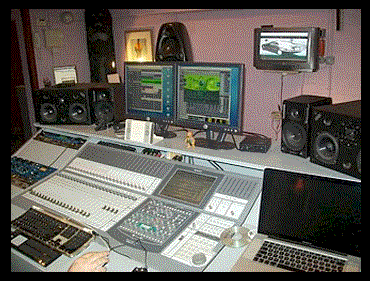
The Elephant House main room 
Things have changed out of all recognition in recording studios ... and especially over over the past decade. Stupidly cheap kit, free audio software and web distribution offer a great deal to musicians. We’re now seeing brilliant work emerging, some of it completely (and rightly) in the hands of the people who create it. It’s not easy, of course: doing all the marketing as well as all the creative work is hard.  But that's for another post.

Our changing times have led to the near-demise of the old-school recording studio. In some ways, it’s no bad thing. The big studios were preposterously expensive. But look around your town, and you'll find some inspiring surprises.

Back in the day, big studios let you put 70 people in a room and create big stuff. Once there were several in the region.  Now there’s only a few left in the country, and they survive on specialised work.
“Of course, everything’s changing now” explains Jon Cotton of Artisan Audio, “because anyone who’s got a laptop or an iPad has a recording studio in their hand.”
 Artisan, in Moseley, has built its reputation on fine albums from Scott Matthews, and through their production company Poseidon, the breathtaking work of Jo Hamilton, of which more below. Other work includes the soundtrack to the feature film 'Nativity' and TV soundtrack work. Like many local studios, they developed from small beginnings and ultimately (and ironically from a 21st century perspective) expanded through record company financing, when Jon’s band of the time, Gramophone, signed a deal with EMI Music.

Do you find that there is pressure to always have the latest wizzbang kit? And isn’t that still very expensive at the professional level?
“Well, we started off that way. Throughout the 90s it was a big selling point – we were (I think) the first studio in the Midlands to have Soundtools, the predecessor to Protools.  Nowadays it's less about the technology, more about having fantastic mics, preamps and outboard.  We’ve got used to hi-tec everywhere, even on our phones. But there came a point where we stopped pushing that aspect, because we, and our clients, pretty much take it for granted."
For a peek into one of Artisan's main rooms, with Jo Hamilton and band, take a look at this clip: 
"It’s more important to us nowadays that we can work quickly and reliably." Jon continues. "We’ve got all the latest and greatest tools for mixing, but past a certain point of sound quality, capturing the performance reliably is more important than chasing high-technology – it doesn't make the music better and sometimes just gets in the way.”
Home studio recording has changed things, and as we’ve said, it’s made life better in lots of ways. But I think a great hole has been hacked out of the studio world by new tech. And the big studios have taken the biggest hits.
“The only way you can get enough business to sustain the massive floor area you need for a big studio is to specialise. So things like orchestral recordings become your bread and butter. That’s happened in London. There are three studios – Angel, Air and Abbey Road, who get almost all the orchestral work, and most of the TV and Film business too. If you go there and do rock'n'roll, great… but that’s almost a sideline now.”
So where does that leave you – aren’t you being squeezed from both sides?
“We’re still offering the studio commercially, and it’s still very busy, a mix of external and Poseidon work.  We have some of Yo-Yo Ma's Silk Road Project coming in on Saturday.” 
Glad to hear it. What about your own creative projects?
"Our focus is Poseidon - our production company. A collection of really good people who really know how to use our tools.  Gear was always the bottleneck. You could only afford a posh studio if you had a record deal, so you could pay 120 grand for 8 weeks week in a top studio. There’s no longer a bottleneck there. So what it boils down to is ideas and craftsmanship; it's what you do with it. Anybody can afford the gear to make an amazing-sounding record. Gotye is a classic example. He’s just got 70 million views on YouTube, and he made that record with basically no gear in a shed.”

Brian.....                           ....and Rob
Over at Elephant House in Balsall Heath, Brian Nordhoff will see your Gotye and raise you… Flux Pavilion
"A 22-year old kid from a high-rise in Birmingham. Last year he did three tracks for will.i.am, and he’s done tracks for Jay-Z and Kanye WestSnoop Dogg phoned him up and he got annoyed… he’s ended up doing a track for Snoop Dogg!  It all started because Jay-Z heard his track on YouTube, and wanted to use it as a backing track. So they tracked him down, and used it. Then will.i.am heard it, and got in touch…"
And did you have any connection?
“It was part of Earl Falconer’s label, Circus, so I came to know about it through that. I just find it really encouraging.” 
One of Earl Falconer’s other non-UB40 projects is Dub Specimen. Their album was largely recorded at Elephant House, and it’s a beautiful album. It’s a taste of what Brian and Rob Cimarosti have worked on. Here's a track from the CD.
Elephant House is one of two production  houses in the area (the other is Friendly Fire Music), specialising in urban, dub and dancehall, and we’ll look at this in detail in a future post. But the studio Brian Nordhoff and Rob Cimarosti work from covers all sorts of different work. The afternoon I dropped by, DC Fontana were adding the final touches to parallel vocals for a new single: one version in Spanish and the other in English. 

Their studio started in the same way as Artisan.
“The Elephant House started because we had a band called Electribe 101. We thought it was dubby electronic stuff, but we were hailed as the forefront of British House. So we were on the front pages of NME, and we got enough money to build this place. We were initially signed to Phonogram, but we walked away…  insane record company politics. We’ve been independent ever since, apart from when we were signed to a company which was taken over by Sony… and the politics began all over again.  We were told the chief exec didn’t feel the album… so they were going to kill it.”
For a revealing account of their record company struggles, go to this page on the G-Corp website. G-Corp? That’s Groove Corporation, the band Electribe 101 morphed into. 
“It was a shame because the album was beautiful. It really annoyed me. We were showcasing six or seven local artists on it. It was everyone’s lives. It was a really nice piece of work. “
I'll second that. Here's a track to savour.
Co-Operation - Showtime
Licking their wounds, production work arrived…
“We built a reputation – ended up being asked to mix or produce some of the heroes of our youth, like Dillinger, Luciano, Big Youth…even Ennio MorriconeSly and Robbie. A lot of our heroes. I mixed Labour of Love for UB40”
Since then, you’ve just been beavering away in this studio? For over 20 years?
“Yes. We’ve never been great fans of fame, to be honest. For us it’s all about the music.  If we can make the music we want to make and pay the rent, great.” 
Are you paying the rent at the moment?
“Just about. But it’s very hard work. We used to sell a lot of records independently, but nobody buys records anymore, they just download them. A recent single,… we just had a look at two torrent sites. It had had 60,000 downloads. Which, if we’d been paid for, we’d have been very happy about. So we’re having to find new ways of doing things.” 
How can you deal with that?
“I don't know that you can. If a track is out there, it can travel. There’s two groups of people. There are some that don’t think too hard. They think everything should be free. But, seriously, tell that to your plumber the next time he comes round. We're going to lose a bed of independent music, because people can’t afford to make it anymore." 
But you give your music away for free when you dish out promo copies, you do free gigs for exposure… When are you in a position to control that, and get paid for your work?
“Live music. We go out with the Overproof Sound System, we do a lot of live work. I suppose as your reputation builds up, so you can command a decent fee.”
And sell your CDs at the gigs?
“Even that’s gone. You’re better off selling an mp3 bracelet.” 
Music’s become commoditised...
“Yeah. I realised the other day…a friend’s son came to me the other day and said I’ve got 8000 tracks on my iPod. So I said ‘What have you got?’ and he said 'Oh, a bit of this, and a bit of that, you know’… But nothing jumped out to him. It totally destroys the importance of music. You’re judged by the quantity of what you have, not by the quality."   
You’ve seen changes. You were one of the first white guys to get involved in reggae production. And that’s got really big in Birmingham. It’s really open and experimental.
“We’ve got a lot going on, without a doubt. But there's always been that black/white cultural mix. Look at Alex Sadkin, who produced Bob Marley and Black Uhuru. Or UB40. Or the house bands at Stax, Motown and Muscle Shoals. I grew up bathed in Reggae!” 
Who else have you got coming in to the Elephant House right now?
"Well at the moment we've put it all on one side - for us! We've got an Overprooof Sound System album to finish, we've got a new G-Corp album that's well overdue, that's got to get done. So unless people are begging us to get in here, we're going to try and get the next few months to ourselves. That's why we built this place originally - it was to do it for ourselves. But both Fontanas are back in at the moment - we've got Fontana Instincts (Folk./Blues/Psychedelia, from Derby), and DC Fontana..." 
All of which tells me that - sometime this summer -  I'll be posting about a lot of new work, when it sees the light of day. Can't wait. 

Links:
Artisan Audio/Poseidon
Elephant House/G-Corp


Sunday, 15 January 2012

The Destroyers cross the PledgeMusic finish line

How one band found online fan funding to support their CD. It wasn't easy...

Louis Robinson in make-up for the video shoot
On January 12th 2012, around lunchtime, the Destroyers hit their target on PledgeMusic.com.

This allowed them to fund the release of their second album. I am delighted for them. I’m not alone: check the Destroyers' Facebook page to read messages of congratulations from all over.

By the way, this here is Louis Robinson with a lot of scary make-up being applied. The Destroyers were shooting a video yesterday for their next single. More on this later.

I’m a big fan. I’d love to see the band grow and prosper.  I’ve been watching the online pledge process closely from the moment they got it underway. It seems to me that the Destroyers played this one just right. But setting up a worthwhile project on one of the many pledge sites is one thing; taking it to fruition is quite another. 

Fan-funded music releases aren’t new. Ten years ago, veteran Scottish pomp-rockers Marillion demonstrated the power of marketing themselves directly to a loyal Europe-wide fan base with spectacular success, when the record industry had long since written them off. Buffalo singer-songwriter Anni DiFranco has put out releases yearly for 18 years on her own label, maintaining and managing direct links to her growing following.


And it’s becoming a much more significant part of the music landscape. I went to PledgeMusic  to look at the successes. On the Funded - that is, successful – page today, the Destroyers are up there, front and centre, one of the most recent projects to cross the finish line. Following on are a string of happily completed projects from around the world. You won’t know most of them, because they all successfully work to their home areas. But if you jump back to the PledgeMusic home page you’ll see some surprisingly big names, not all of whom have been successful. Many are: there’s Reef, and Killing Joke, who have both wildly exceeded their targets, and in so doing, sidestepped the conventional record industry to great effect. But look – here’s Ian McCullough, a name to conjure with from the 70s and 80s, who has yet to hit the 100% mark. I think he probably will – he’s three quarters of the way there and he still has another two months to gather the remaining pledges of support.

Pledge sites work by inviting fans to contribute towards a total sum. This funds a CD, or a DVD, or a film, or an EP, or an artistic activity. There are dozens of such sites covering all sorts or artistic activities, but they tend to work in much the same way: your pledges are only redeemed if the entire project hits its target. So there is a risk of failure. And of course, if you fail, your failure is both public and extremely disappointing for the band and fans.

When the Destroyers kicked their campaign off late last year, they rapidly hit the 30% pledge mark,  offering a range of goodies to pledge for from straight downloads to signed items, and even attendance at a rehearsal followed by dinner with the band at a mere £140. This is a bargain: you have to fork out 500 Australian dollars for dinner with The Murphy Brothers, a three piece from Western Australia. After that encouraging start, things slowed down a little bit. Then, alarmingly, things slowed down quite a lot. The percentage total, loping gently but steadily upwards, started to crawl. And after Christmas, for obvious reasons, things got sticky. With a week to go, they were still some 20% off their target. However, recent days saw an explosion of online activity to raise awareness. Band members, friends, fans, family and fellow musicians, tweeted, posted and nagged. The band kept up a steady stream of posts, offering video clips and extra treats for those who had already pledged. I wasn't sure anyone eventually came in for Louis Robinson’s framed beard, though - a snip at £69. 

I met with the band at their video shoot (in a backstreet boozer a stone's throw from the Birmingham markets area) to talk over their campaign.Louis  was more than happy with Pledgemusic: 
“They get involved. You talk to them at least once a week, and it’s always the same person, so you develop a relationship. They’ll tell you about other campaigns on their site, and suggest you try this or that.”

It looked at one time that you weren’t going to hit your target. Do you think you were realistic in setting your financial goal?

“Yes. We weren’t asking for a huge amount – enough to press up a few thousand CDs, cover some mixing costs and bits and pieces. The bigger your following, the more you can aim for. But Pledgemusic are also pretty good at suggesting a realistic target. And they check you out before letting you sign up – they look at your site, see how many Facebook likes you have see, listen to your music, read the reviews…”

Louis, you still have your beard. Didn’t anyone pledge for it?

“Oh, they did. There will be a ceremonial presentation. There may be video footage in due course...."
Isn't there the awful risk that you might actually fail in your attempt to raise funds? I saw an awful lof of low percentage pledges on PledgeMusic...
"Yes, there is that risk, and we were well aware of it as we approached the deadline day. But PledgeMusic, like I said, were, extremely helpful in suggesting strategies."

Paul Murphy and Sam Wooster (trumpet) talked about the dog days of the campaign.

Sam: “When we got to about 60% of our target, with two weeks to go, I was a bit worried. But then it all came together. We got everyone working their own social networks - lovers, families, friends...”

Maybe your timing could have been better? You hit the slow stage right after Christmas, when everyone was flat broke. It was a bit touch and go there for a while...

Paul: “Robin, we really didn’t have a lot of choice. In planning the album release, tours for this coming year, a first single (Hole In The Universe), and everything else, this was how it had to be. But so many people came onboard with our last minute campaign, by posting and tweeting about us, it spread the word further. And we were able to offer a few exclusive goodies to our pledgers – so that helped.”

And with that, it was back to the video shoot. They were running late, of course. Here's the result:


Lessons learned?
Think it through. Design a campaign. Get your project up. And then sell it, hard, repeatedly, and shamelessly. Find angles. Enlist support. Get the project to go viral if you can. As with so much of today’s music industry, the onus comes back down to the artist. Your fans may love you to pieces, but your job is to convince them to part with money online. To many, that’s a contradiction in terms. And remember that you are in competition with dozens of equally deserving projects, some of whom will be by people you know. The day I went down to meet with the band, two more fan-funded appeals landed in my email inbox. I suggest you take a look at the freshly launched appeal project on WeFund.com from the wonderful Wes Finch. (Update: this project has now hit is funding target too)

By the way, if you’re nosing around Balsall Heath, and you just happen to spot a very battered and tarnished Tuba, Mark Davis would like it back, please. He only put it down for a second, went back inside, and came back to find it gone. Maybe the scrap metal boys came down his street while his back was turned. Now, it may only have cost £20 and a bit of elbow grease to convert it back to from its function as a plant pot; it may not have a perfectly brilliant tone. But it’s the Destroyers’ tuba, dammit, and they want it back.

My congratulations go to the whole band. Now, where’s my CD download?

See also
Scoring big national airplay: how two local bands did this

Wednesday, 30 September 2009

You never know who's listening...

I visited the Brussels Museum of Musical Instruments last month. It's brilliant. They give you wireless headphones which spring to life when you approach the display cases: you get a blast of a Mozart wind quintet on period instruments, or some stonking Hurdy Gurdy dance music, or a bit of steaming Hammond B3. It just brings those wonderful old instruments to life. And, of course - this is a state museum in the capital of Eurobureau - it is very fully documented, with discographies and notes. But: did they ever miss a trick... a big one too...

That Mozart piece blew me away. I love Mozart, and this, played on warm and subtly toned period instruments, was just gorgeous. I had to have it. So I visited the museum shop, where a deeply cool and painfully crucial guy with a wicked 'do cooly and politely informed me that, no, there were no CDs available with any of the museum's music samples - just what they had on the shelves... there might be a bit of Mozart wind stuff over there....

I was tempted to ask him if he had trained in retail in the UK, but I passed. He wouldn't have understood.

In all seriousness, this represents a completely wasted opportunity. Here is a museum which attracts music lovers. During their visits, these music lovers are exposed to a tantalising range of fantastic music - hundreds and hundreds of samples, effortlessly brought to life in a charming and accessible way. I would probably have come away with several CDs had they been available for purchase. Of course, there are bound to be copyright issues, but I don't see that these couldn't have been overcome. If I ran a record company, I would happily have made appropriate samples available to the museum, in exchange for their shop stocking the source CDs. It just makes simple business sense, and, provided
the curatorial goals of the museum drive the process, there is no reason that the profit motive should override things.

However, since this is a Radio and Local Music booster blog, you may well be asking by now why I am spending so much time banging on about wasted business opportunities in Brussels.

Well, I've got two reasons, the most important of which is this: every time you go on the air, or play a gig, or get your song on the radio, you get a chance to sell yourself. And you never know who might be listening.
Don't ever be content to put something lovely together, like the fabulous Brussels MIM, and then skip a chance to press home your advantage. It may just be a dumb tourist, like me in the Museum, asking the questions. But it could be a listener. Or someone who wants to buy your stuff.

This all connects up. Really, it does. There's been much talk lately - see my previous post, and a new post up today on the Infinite Dial blog - about the creative areas, where new radio practitioners are bypassing the old-school network operators, to go straight to their audiences. New ideas and new approaches are being born every minute, and I welcome them. Podcast and community radio audiences might be tiny right now, but you can bet that in among these audiences, there are movers and shakers, future bosses and future decision makers. They're listening right now, because they too are looking to find new inspiration.

Second reason - I just got friended on Facebook by a local muso, Mick Howson... who plays the Hurdy Gurdy... which reminded me about the Brussels MIM. See? It all does connect up.


Sunday, 9 August 2009

Decline and fall?

I read a book review last week of a work covering the spectacular, ego-driven, cocaine-fuelled, decline and fall of the record industry. As I was prepping this post, I checked on Amazon on to be sure I had the title right, looking for books on the Record Industry, decline and fall of. Blimey, there's dozens of them. Talk about Hollywood Babylon revisited.

Record industry depravity aside, the review sparked a notion for this post. Some years back, a very savvy and smooth operator, Tim Blackmore, was in charge of the Radio Academy. This is a UK industry talking shop, and I was, and still am, a member. If you care about broadcasting in the UK, you should be a member too. Tim set up a meeting which brought together music radio types and some senior music producers - respected players in the then ego-driven, cocaine-fuelled, etc, etc, record industry - to discuss common ground. You know, all music lovers together, that sort of thing.

Only trouble was... there really wasn't any common ground. Early on, I wittered on worthily about radio's need to relate to its audiences first and foremost, and if that meant radio could support record industry priorities, that was fine and dandy; but that we could not honestly be expected to place their priorities above our own. Blissfully unaware of their reactions, I ploughed on about it was now difficult to trust the chart as a barometer of public taste, and how it made sense to do some research into local sales patterns.

Well, that went down like a lead balloon with the producers. And when the producers in turn talked approvingly about hyping sales to put records into the charts so that radio would be forced to play their product, that went down like a lead balloon with me and not a few others.

Of course, that was in the days of serious audience figures for Top Of The Pops, when Radio 1 was the biggest station in the UK, and Radio 2 was definitely... not. Since that time, record sales have largely tanked, the chart has lost all credibility as a programming tool, and a lot of radio has programmed increasingly conservatively using in-house research. What we didn't expect then was the web: This punched a dirty great hole through all our cosy assumptions. I'm not unhappy at the changes: I'm hearing so much great music from the web - stuff that doesn't fit the financial model the record industry grew fat on. And, as I have already said, I'm not at all unhappy that thousands of new players are experimenting with radio, also on the web.

What I would like to see is some way that the new cream can rise to the top. We're not there yet. But I'm happy to wait. In the meantime, I would love to see a companion Radio Babylon-style book or two about the ego-driven cocaine-fuelled big beasts... of radio... back in the day.