Showing posts with label Jo Hamilton. Show all posts

Saturday, 24 March 2012

Don’t you point that thing at me, pal. Snapper supreme Richard Shakespeare shares some thoughts.


Music Photographers: in the pit, hanging off the balcony, vilified by tour managers. A key part of the industry. 


I posted a year or so back (interviewing Bob Marley) about how useless and in the way a DJ is when he’s backstage at a gig. The only people who really should be backstage are those people who have a job to do. The rest is glory-hunting.

Photographers, for the most part, tread a delicate line. They may be have been invited to document the gig. They may be there to further their own careers. But sometimes they just need to go where they really shouldn’t, just to get that special shot. It calls for tact, diplomacy and sometimes a lot of brass neck.

Leominster-based Richard Shakespeare runs the wonderfully named Shakeypix, and has long and generously let me grab his work for this blog. I’ve watched him at work for the last two years or so. No spring chicken, he, but a great snapper. At gigs, he's everywhere - turning himself into a pretzel in the pit, upstage, downstage, in the balcony... smiling, deep in concentration, watching everyone and everything. I talked to him about the job. 


Why photography? 
"I’ve always had a love of image and form. I tend to see everything through a frame. My parents gave me a box brownie for Christmas. I was 8. Then I had a Prinz 110 from Dixons, bought with paper round money. It was nice and compact, but the quality was rather poor. At 15 I went on a course, one afternoon a week, at the local photography college. I picked up a 35mm SLR for the first time. I loved the old darkroom developing process. It went on from there." 
George Barnett and The Ninth Wave at the Yardbird, February 2012
The last time I watched Richard working, he was cheerfully squeezing himself through the crowd at a packed Birmingham boozer as his new charge George Barnett (of which more below) played a debut gig in the area. He was all smiles – a large, uninhibited, jovial presence, firing off shots of the crowd, the band, their friends and family. 

You don't make yourself invisible. Others do. What's your approach? 
"I see no point in being invisible. My clients tend to respond well to this. With a name like mine it's very hard not to be noticed. If a client wanted it otherwise I’d adapt."
When you went full-time, what kit did you buy? 
"It was in 2007. I decided to go with Canon or Nikon digital. The final decision was based on a pro snapper who used Nikon, but told me he wished he’d gone with Canon. So I soon found myself armed with 4 pro Canon DSLR's and a large selection of L lenses. For live work I travel light, packing all I need into a small sling style bag. A full blown shoot requires a serious number of bags, lenses, lights etc. This is where assistants come in – there’s always someone willing to give me a hand." 
Mendi Singh with Alternative Dubstep Orchestra, Mostly Jazz 2011
Studio work or live in the field?
"I don't have a studio. It’s too tame. And too costly. I’ve got all the kit I need to set up a studio anywhere, and locations are so much more interesting. Many bands send me their rough ideas and backdrops. I then go out and source locations to suit. Birmingham bands like to come here (Herefordshire) as it’s so different to the usual Digbeth/urban backdrop. Plus we all enjoy a meal and great banter in my kitchen afterwards." 
You shoot lots of stuff for the love of it. How can you make it pay? 
"Good question, it's not all about the money for me. I can work my prices to fit budgets. I used to do some live work for free to find new clients. That’s how I built up long term relationships. Being trusted is everything to me – that’s how you get the money shots that others miss.
Paul Murphy, Songwriters Cafe, Summer 2011
"! always look for the real person, not someone who’s aware of a camera in their space. I’ve been known to pull faces at someone onstage or dish out the odd insult when face to face in order to get a reaction. But I always follow it with a smile and a thank you." 
It’s a crowded field. Is there a sense of community or a sense of competition?
"It’s competitive, but I try not to enter that game. Each photographer will have their own style. Most UK music photographers have a lot of respect for each other. We share space and time: we’ll all chat before entering a pit, then whoever has the best spot will get their shots and move to give others a chance. I find that just a few London based snappers let the side down and fail to understand that mentality." 
Mark Magoo Robinson, Leftfoot 10th Anniversary Special
You have long-term relationships with bands like the Destroyers, the Misers and Goodnight Lenin. How does that work?
"There are many bands I’ve built up an understanding with. I’m rather lucky to have made so many musical friends.
"Goodnight Lenin came to me about 3 years ago. I was recommended by a mutual promoter friend. They were in the planning stages. The budget was tiny. I drove to Edgbaston and did an all-day shoot for the cost that just about covered the petrol. We all got on like a house on fire. About 3 months later they had their first live show, and I was invited along. At this point I had no idea what kind of sound they had. I loved the music and the rest is history. I have now become the band archivist and been at their sides for nearly every gig."
Goodnight Lenin on tour, March 2012
 "The snapper role was then combined with that of tour manager last year, which sadly has had to go. I love those boys like the sons I never had - I have two daughters. The deal is all about budget. As a band’s kitty grows then my fee will reflect their situation. This way we can grow and reach our goals together. To be taken on tour by a band opens lots of great opportunities to get exclusive one off’s. These days I would rather do that than shoot the actual show, although I do both." 
What about big contracts? 
"I’m not sure that I want large contracts. They can end up being a chain around your neck. I worked with Florence And The Machine, shooting a number of the early shows while they were on the rise. They have always been good to me, and I love them dearly, but now for me the machine is the industry, not the band, which saddens me."
"To be honest, when you’ve got to jump through hoops to get a photo pass, I just can’t be bothered. I’d rather just move on. But I have picked up some interesting work off the back of the music work. Last Summer I did a shoot for Echo Falls the wine company, who wanted product placement at the Isle Of Wight Festival. Life is never dull!" 
Can we talk about your health? Say no and I won't. But to me it's part of the story. 
"Sure. I have always been healthy. Last summer, with 16 festivals covered and two still to go, I got a life-changing shock. My age must have kicked in and sent my body a warning message. I had a stroke, which left me on a hospital ward for a week, followed by months of recovery and reflection. Many of my industry friends like Goodnight Lenin, The Misers, Jo Hamilton with Jon Cotton and fellow photographer Wayne Fox with Sara paid me regular hospital and home visits. My dear friend Tiffy B (she's worked with Lady Gaga and CeeLo Green) even dropped in after coming off tour with Tricky. So many people sent cards and Facebook messages. But it was clear that I’d have to change my working life." 
But you’re back. Now tell me why you decided to go manage a band. At your age and all.
"As I recovered from my illness, I was weak and rusty - I’d gone a month without picking up a camera. I couldn’t drive for 6 weeks. I was not well enough to travel far from Herefordshire; Birmingham was too far. I looked around for a local artist and offered a free shoot to keep my hand in.
"The artist I found was the then 17 year old George Barnett, a former Young Drummer Of The Year. George invited me to a gig at The Bull in Ludlow, not far from my home - my first gig in ages. Yes, it was a pub gig; yes, it was not the best venue, and, yes, there were not hundreds people there, but WOW … he blew me away." 
"A big talent, right under my nose. A week or so later we arranged a photo shoot with George and his band The Ninth Wave. The first set of photos were in the bag. After a few more meetings George asked me if I would consider being his manager. A couple of days of days later, I decided to take him up on his offer. Since that time my world has moved to its next phase. I still take photographs, and recently went around the UK with Goodnight Lenin with Beth Jeans Houghton as support. My tour managing is on hold, whilst I concentrate on my new role of developing a very special talent, and I’m sure in years to come he will be a National treasure. The debut George Barnett album 17 Days (here's the bandcamp link) was released on 12th March 2012." 
What about favourite shots and subjects? 
"So many! My most well known shot is a live one of Florence taken at Shepherds Bush Empire. The London tog’s were all squashed into the pit with not even room to pass each other.
I had snapped most of the tour and had sorted out with the lighting guy to give me more light in the first song, as we were only able to shoot the first 3 songs. Lighting on Flo had been very dark. Not wanting to enter the pit scrum I decided to sit on the side of the stage, and so took my shots from a different angle to the others. It wasn’t until I got home I realised that the money shot was in the bag. So that was a bit special.
"I have a lovely one of Carl Barat (Libertines/Dirty Pretty Things) taken in the green room after a London showcase that hangs in my home. Carl said he couldn’t see it being a good shot, but after looking at the result he soon changed his mind." 
"An early Tinie Tempah taken in his Rainbow dressing room is another favourite."
"I also love an unusual snap of Robert Plant (see this at the top of this post), taken backstage at the Mostly Jazz festival last summer.
"Robert had just flown in from the USA and was very tired, but he still had enough fun left in him to pick up a jug of flowers and hold it up whilst gesturing with one finger that there is only one Plant."  
"Roisin Murphy (ex Moloko) will always have wallspace in my home, but my favourite shot of her was taken on Moloko’s final tour, by my daughter Laura with a happy snaps camera and shows Roisin jumping on my back."
Links: 
Shakeypix
George Barnett website  

See more posts on photography on Radio To Go

_________________________________________________________________________________


Sign up to the mailing list for weekly updates


_________________________________________________________________________________

Monday, 5 March 2012

Artisan and Elephant House studios

In between laptop kids and big budget operations, music studios are diversifying to survive. Two local operators,  doubling as production houses, 'fess up... 
The Elephant House main room 
Things have changed out of all recognition in recording studios ... and especially over over the past decade. Stupidly cheap kit, free audio software and web distribution offer a great deal to musicians. We’re now seeing brilliant work emerging, some of it completely (and rightly) in the hands of the people who create it. It’s not easy, of course: doing all the marketing as well as all the creative work is hard.  But that's for another post.

Our changing times have led to the near-demise of the old-school recording studio. In some ways, it’s no bad thing. The big studios were preposterously expensive. But look around your town, and you'll find some inspiring surprises.

Back in the day, big studios let you put 70 people in a room and create big stuff. Once there were several in the region.  Now there’s only a few left in the country, and they survive on specialised work.
“Of course, everything’s changing now” explains Jon Cotton of Artisan Audio, “because anyone who’s got a laptop or an iPad has a recording studio in their hand.”
 Artisan, in Moseley, has built its reputation on fine albums from Scott Matthews, and through their production company Poseidon, the breathtaking work of Jo Hamilton, of which more below. Other work includes the soundtrack to the feature film 'Nativity' and TV soundtrack work. Like many local studios, they developed from small beginnings and ultimately (and ironically from a 21st century perspective) expanded through record company financing, when Jon’s band of the time, Gramophone, signed a deal with EMI Music.

Do you find that there is pressure to always have the latest wizzbang kit? And isn’t that still very expensive at the professional level?
“Well, we started off that way. Throughout the 90s it was a big selling point – we were (I think) the first studio in the Midlands to have Soundtools, the predecessor to Protools.  Nowadays it's less about the technology, more about having fantastic mics, preamps and outboard.  We’ve got used to hi-tec everywhere, even on our phones. But there came a point where we stopped pushing that aspect, because we, and our clients, pretty much take it for granted."
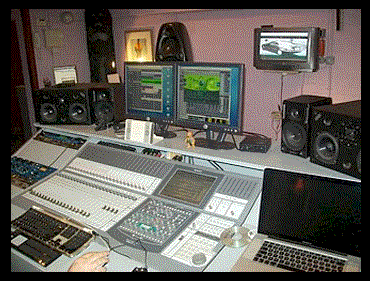
For a peek into one of Artisan's main rooms, with Jo Hamilton and band, take a look at this clip: 
"It’s more important to us nowadays that we can work quickly and reliably." Jon continues. "We’ve got all the latest and greatest tools for mixing, but past a certain point of sound quality, capturing the performance reliably is more important than chasing high-technology – it doesn't make the music better and sometimes just gets in the way.”
Home studio recording has changed things, and as we’ve said, it’s made life better in lots of ways. But I think a great hole has been hacked out of the studio world by new tech. And the big studios have taken the biggest hits.
“The only way you can get enough business to sustain the massive floor area you need for a big studio is to specialise. So things like orchestral recordings become your bread and butter. That’s happened in London. There are three studios – Angel, Air and Abbey Road, who get almost all the orchestral work, and most of the TV and Film business too. If you go there and do rock'n'roll, great… but that’s almost a sideline now.”
So where does that leave you – aren’t you being squeezed from both sides?
“We’re still offering the studio commercially, and it’s still very busy, a mix of external and Poseidon work.  We have some of Yo-Yo Ma's Silk Road Project coming in on Saturday.” 
Glad to hear it. What about your own creative projects?
"Our focus is Poseidon - our production company. A collection of really good people who really know how to use our tools.  Gear was always the bottleneck. You could only afford a posh studio if you had a record deal, so you could pay 120 grand for 8 weeks week in a top studio. There’s no longer a bottleneck there. So what it boils down to is ideas and craftsmanship; it's what you do with it. Anybody can afford the gear to make an amazing-sounding record. Gotye is a classic example. He’s just got 70 million views on YouTube, and he made that record with basically no gear in a shed.”

Brian.....                           ....and Rob
Over at Elephant House in Balsall Heath, Brian Nordhoff will see your Gotye and raise you… Flux Pavilion
"A 22-year old kid from a high-rise in Birmingham. Last year he did three tracks for will.i.am, and he’s done tracks for Jay-Z and Kanye WestSnoop Dogg phoned him up and he got annoyed… he’s ended up doing a track for Snoop Dogg!  It all started because Jay-Z heard his track on YouTube, and wanted to use it as a backing track. So they tracked him down, and used it. Then will.i.am heard it, and got in touch…"
And did you have any connection?
“It was part of Earl Falconer’s label, Circus, so I came to know about it through that. I just find it really encouraging.” 
One of Earl Falconer’s other non-UB40 projects is Dub Specimen. Their album was largely recorded at Elephant House, and it’s a beautiful album. It’s a taste of what Brian and Rob Cimarosti have worked on. Here's a track from the CD.
Elephant House is one of two production  houses in the area (the other is Friendly Fire Music), specialising in urban, dub and dancehall, and we’ll look at this in detail in a future post. But the studio Brian Nordhoff and Rob Cimarosti work from covers all sorts of different work. The afternoon I dropped by, DC Fontana were adding the final touches to parallel vocals for a new single: one version in Spanish and the other in English. 

Their studio started in the same way as Artisan.
“The Elephant House started because we had a band called Electribe 101. We thought it was dubby electronic stuff, but we were hailed as the forefront of British House. So we were on the front pages of NME, and we got enough money to build this place. We were initially signed to Phonogram, but we walked away…  insane record company politics. We’ve been independent ever since, apart from when we were signed to a company which was taken over by Sony… and the politics began all over again.  We were told the chief exec didn’t feel the album… so they were going to kill it.”
For a revealing account of their record company struggles, go to this page on the G-Corp website. G-Corp? That’s Groove Corporation, the band Electribe 101 morphed into. 
“It was a shame because the album was beautiful. It really annoyed me. We were showcasing six or seven local artists on it. It was everyone’s lives. It was a really nice piece of work. “
I'll second that. Here's a track to savour.
Co-Operation - Showtime
Licking their wounds, production work arrived…
“We built a reputation – ended up being asked to mix or produce some of the heroes of our youth, like Dillinger, Luciano, Big Youth…even Ennio MorriconeSly and Robbie. A lot of our heroes. I mixed Labour of Love for UB40”
Since then, you’ve just been beavering away in this studio? For over 20 years?
“Yes. We’ve never been great fans of fame, to be honest. For us it’s all about the music.  If we can make the music we want to make and pay the rent, great.” 
Are you paying the rent at the moment?
“Just about. But it’s very hard work. We used to sell a lot of records independently, but nobody buys records anymore, they just download them. A recent single,… we just had a look at two torrent sites. It had had 60,000 downloads. Which, if we’d been paid for, we’d have been very happy about. So we’re having to find new ways of doing things.” 
How can you deal with that?
“I don't know that you can. If a track is out there, it can travel. There’s two groups of people. There are some that don’t think too hard. They think everything should be free. But, seriously, tell that to your plumber the next time he comes round. We're going to lose a bed of independent music, because people can’t afford to make it anymore." 
But you give your music away for free when you dish out promo copies, you do free gigs for exposure… When are you in a position to control that, and get paid for your work?
“Live music. We go out with the Overproof Sound System, we do a lot of live work. I suppose as your reputation builds up, so you can command a decent fee.”
And sell your CDs at the gigs?
“Even that’s gone. You’re better off selling an mp3 bracelet.” 
Music’s become commoditised...
“Yeah. I realised the other day…a friend’s son came to me the other day and said I’ve got 8000 tracks on my iPod. So I said ‘What have you got?’ and he said 'Oh, a bit of this, and a bit of that, you know’… But nothing jumped out to him. It totally destroys the importance of music. You’re judged by the quantity of what you have, not by the quality."   
You’ve seen changes. You were one of the first white guys to get involved in reggae production. And that’s got really big in Birmingham. It’s really open and experimental.
“We’ve got a lot going on, without a doubt. But there's always been that black/white cultural mix. Look at Alex Sadkin, who produced Bob Marley and Black Uhuru. Or UB40. Or the house bands at Stax, Motown and Muscle Shoals. I grew up bathed in Reggae!” 
Who else have you got coming in to the Elephant House right now?
"Well at the moment we've put it all on one side - for us! We've got an Overprooof Sound System album to finish, we've got a new G-Corp album that's well overdue, that's got to get done. So unless people are begging us to get in here, we're going to try and get the next few months to ourselves. That's why we built this place originally - it was to do it for ourselves. But both Fontanas are back in at the moment - we've got Fontana Instincts (Folk./Blues/Psychedelia, from Derby), and DC Fontana..." 
All of which tells me that - sometime this summer -  I'll be posting about a lot of new work, when it sees the light of day. Can't wait. 

Links:
Artisan Audio/Poseidon
Elephant House/G-Corp


Saturday, 23 January 2010

Well, hello there... my, it's been a long, long time...

How am I doing? Ya really wanna know? Well, I guess I'm doing fine.... There's a prize for the first person to spot the song AND the classic 60s singer whose version I'm thinking of, by the way.
My apologies for the dearth of posts at the end of last year. The fact is, I was NOT doing at all fine a month or two back.... Not at all. But now I am.
So here's a first post for 2010, to tell you about a bright new and ever-so-slightly-viral-marketing style initiative from the wonderful Jo Hamilton, which you really should take advantage of.

Jo will present to you - if you go through the right motions - a free concert, online, live and direct from Artisan studios, on January 30th. An e-concert, if you will, at 7.00pm GMT. All the details are on Jo Hamilton's facebook page, or if you are so over the Social Media thing, look at this specific page on her site.

Bottom line? Jo is asking you to post a review on the Amazon page for her album Gown. That spreads the word on Amazon. And it gets you into the e-gig. It's not much to ask for something as intimate and engaging as this will be. I know of what I speak, as I attended one such similar event, but in person, when we worked together on a podcast in Spring 2009 . You should never pass up an opportunity to see an artist like Jo at work, especially in as close and intimate a setting as this. Go get those e-tickets!

Thursday, 25 June 2009

Fantastic: Jo Hamilton and Urban Folk Quartet debut

Only slightly put off by a snotty post in today's Guardian about the decline of blogs, I'm happily resuming blogging here after managing to revive/retrieve my logins so I can post again. Lovely (and free) though this service is, you wind up going round in circles when Google sends retrieval information to your gmail address... which shares the same login as your blogger page.
No matter - I'm happy to be behind the tech curve. This month, I caught the full debut gig of the jaw-droppingly skilled Urban Folk Quartet at the Crown in Moseley. They don't sing; they play, and how. Birmingham has a wealth of fantastic bands, and this is just the latest development in the folk/world/jazz field. These bands swap musicians with wanton promiscuity - I could have sworn I'd seen the cajón player before. Two fiddles, bursts of mandolin and breathtaking guitar work, percussion and rhythm, and a crowd that went berserk. Lovely. See them soon.
UFQ supported the fantastic Jo Hamilton at her album launch gig a few weeks back. I've seen her twice since then, and she has blown me away each time. Watch out for a video podcast, which I'll post details on soon. On it, I had the extraordinary good fortune to interview her as she sang live in the studio, with a small band. it was thrilling to see her perfom live at close quarters, and to be able to talk to her, immediately, off the back of the peformances. Jo is super-smart, witty and sensitive; she has terrific songs; for me, the interviewing of an artist doesn't get much better than this.