Showing posts with label Balsall Heath. Show all posts

Sunday, 14 October 2012

We do it because we love it. All you have to do is find it

Great, unusual music, there to be explored and enjoyed. Free. Bring your curiosity and a sense of adventure.
Zirak Hamad plays the Daff hand-drum. Amazingly.
I first met Zirak Hamad at one of Paul Murphy’s Songwriters Café sessions. Zirak is a lovely guy, irrepressibly enthusiastic, and a terrific musician. He has a hair-raising background, which makes his current situation all the more remarkable. Zirak is largely responsible for a fascinating new musical development in Balsall Heath, an inner city part of Birmingham: Musikstan, which, every other Thursday, gathers musicians to play together from, literally, around the world. It runs on love and goodwill. 

Entry is free, but you really should make a contribution when they pass the hat around; there are musicians' expenses to pay and the event has running costs to cover. Zirak’s music is great – there’s a Musikstan clip or two to enjoy after the jump. And while it’s a worldwide music thing, chances are you’ll catch some delicious local musical collaborations, as some of Birmingham's finest have started to drop by.


Zirak’s Musikstan gigs are by no means the only music gatherings in town that run on similar lines. Once a month on Sunday afternoons on Moseley, you can catch stunning musicianship, organised by the magnificent percussionist Joelle Barker at the Dance Workshop. On top of that, the City centre Island Bar hosts the Free Love Club, an all-dayer of a folk-ish bent, for free, on Sundays; Sue Fear’s Moseley’s Muso Monday, also (logically) on Monday nights, works on the same principle, there are regular gatherings of different music stripes at the Tower Of Song; and of course there are many more such events.  If I've missed yours out, I apologise - but please do let me know for future reference. 

Here's Zirak, at Musikstan, tearing it up on the Daff hand-drum. I recorded this in September.


Zirak kicked off Musikstan in March of this year. It’s got a clear and simple goal.
Zirak Hamad: Musikstan is about sharing and bringing people together. The business side of music is important, but having music just for music’s sake is important too.  A friend of mine, Andrew Bland, invited us to play at the Old Print Works, and accompanied us on piano.  And it gave me an idea to do something regular. So that’s how it started. Musikstan is based on bringing different musicians together, from different backgrounds and different styles. People are able to ask questions about the music, about the backgrounds and the styles of each type of music. 
In the six months since you started, how has the network of musicians developed, with different people coming in to play?
To start, because I’m a musician, I can bring in many musicians that I know. But then word got out – word of mouth – about Musikstan. Session by session, it developed; musicians contacted me to come and play. We keep it very informal. Musicians are invited to join us, and we leave time for the audience to ask them questions at the end of their set.  We aim to have one musician from Birmingham, and one from outside of the area, because we want musicians to meet and exchange ideas and music, and play together. 
What about your own music?
I have a Kurdish band, and I also have a band called Village Well, which has an Indian tabla player, and a Caribbean steel pan player. I also play in a gypsy band with an Albanian and a Romanian musician…. 
Tell me about your band Village Well….? 
We got the idea in 2010, with a Khora player, me on violin, and Indian Tabla from Pritham Singh. Unfortunately, the Khora player, who lives in London, could not stay with the band, so we added Norman Stewart on Steel Pan instead. This brings all kinds of people together.  Some Kurdish people might come to see me, and Indian people because of Pritham… and Caribbean people because of Norman. So we really are bringing people together through music. 
If you went back to the old country now, after your years in the UK, what would happen? How would people react to you?
Kurdistan has changed a lot since Saddam Hussein’s regime. Kurdish people are more open-minded now. When I went back, I was made very welcome. When I left Kurdistan, I had 24 hours. I found out that a friend of mine – who was working with the Intelligence services under cover – that the next day, they were coming to arrest me, and god knows what would have happened to me afterwards.
So it was: don’t go to work tomorrow, and sort yourself out to get away, because everything was going to end for me. I left Kurdistan straight away. After ten o’clock, they went to my house, and my family said they didn’t know where I was. And that was the truth – they didn’t know where I was, or how I had left. I went to Iran, and then to Turkey, and then  in the end I came to England.
Are your family …OK?
They weren’t. They arrested them and tried to force them to tell where I was. But they didn’t know, because I didn’t tell them what I was doing. So the secret police accepted this - in the end. Now, after Saddam ‘s regime, they’re all right. We have our own government; people are more liberal, and more free…
Did you come to the UK and claim asylum? 
Yes, they gave me asylum. I had to pay a smuggler to get me to the UK. My family supported me, though friends, not directly. We couldn’t use the phone or anything like that….  
So this must have cost your family a fortune in the end.
About 8000 dollars. That’s a lot of money in Kurdistan. 
It’s an extraordinary story, but Zirak might well say that everyone is extraordinary. Now settled in Birmingham, Zirak runs school workshops in middle eastern dance and  music. In 2003, he organised a Kurdish band: Daholl Kurdish Ensemble, as Birmingham didn't have any Kurdish musicians at the time. And his dream is to see Muzikstan become a world music festival in the UK. 

So now he’s  back doing what he loves, which is making music, and working with other musicians. And, as always, this being a Birmingham thing, there’s a lot of collaboration. Paul Murphy has played at Musikstan, as has Joelle Barker, and there’s some mighty collaborations planned for the future. Live, experimental cross-cultural collaborations in an intimate acoustic environment: it’s not something you can bottle. You have to experience it. . Long may it continue

Links: 

Muso Mondays at the Station, King's Heath, Birmingham

Tower Of Song -

Songwriters Café 

Tuesday, 1 May 2012

Birmingham Reggae production houses and the third generation. Friendly Fire, The Elephant House and more

They say Birmingham exports more reggae and sends more bands and sound systems out on tour than Jamaica. That's a hell of a statistic.

True or not, 21st century Birmingham reggae is still huge. It's still at the heart of music making in the city: a continuing hotbed for reggae, dancehall and old-school/new-school mash-ups. Sympathetic promoters and enthusiastic audiences abound. There are (at least) two production houses, both in Balsall Heath, pretty much a stones’ throw apart. There's way more to talk about than one blog post can cover. 

If you trace 70s and 80s Birmingham music, the emphasis eventually lands squarely on reggae and cross-cultural mixes. Much of this came from Handsworth and Balsall Heath: tough, inner city areas with overlapping cultures - always promising from a musical perspective. Handsworth had the edge, with Steel Pulse, Ruby Turner, Cornerstone, Beshara and Apache Indian, and many others. But Balsall Heath can lay a powerful claim, being home to most of UB40 for many years. 

With Andy Hamilton’s generation as a starting point, all of the above are second generation reggae/soul artists. British by birth, and from a bewildering range of backgrounds, all of them happily worked, and mostly still work, across a whole pile of musical genres. 

Robin Giorno’s Friendly Fire operation has been up and running for around ten years. He takes an old-school view, working with a core set of musicians  - Friendly Fire Music - who back up both local artists and visiting stars from the old country. Most of Robin’s work sees the light of day on his own label, and he also backs his music and label work up with regular JamJah Sound DJ sets, setting himself a ferocious schedule. If you check out the PST and  Reggae City Festival sites, he's there - with his band or as a DJ.

Friendly Fire Music with Lionart - Badness

Friendly Fire HQ is an unconventional but effective studio and production centre, spread across several rooms, and leveraging both old-school techniques and web-powered tools. It can be a one-stop shop, with a production chain marked out by a mic and shield rig and decks at one end, and a CD duplicating machine at the other.

Robin Giorno is French; he came to the UK at 18 to study electronic engineering. It’s a complicated story. 
"Studying in England is different. In England it’s much more along personal development lines, whereas in France it’s much more rigorous. If I’d stayed in France I’d have only met other engineers; in England I got fully involved in…. all sorts of areas." 
Including Reggae? 
"I started listening to Reggae a couple of years before I left France; all the old-school guys like Marley, Toots, Gladiators, all the roots 70s guys."
So were you aware of the second-generation Birmingham reggae tradition?
"I don’t think I was! But I wound up going to Summit Records in the Bullring… and all these songs I could only hear on the radio, on Friday nights from 10.30 till 11.30 …they were all there! I could get the whole album! So Winston, who runs Summit, he guided me a little bit."
"Now those Indie shops are disappearing, the guys like Winston who fulfilled that role – the benevolent guy behind the counter who turns you on to this or that sound – are getting rarer and rarer. We’re going to pay for that in the end."
Robin's exactly right there. Losing the bricks and mortar stores is a 21st century tragedy. Record shopping online works fine, but there's no soul or passion, and it's driven most old-school stores to the wall.. 

Robin had already cut his teeth on guitar as a teenager in France, into Kiss and Glam rock, but his first UK band is still the band he plays in now. It emerged from some looped experimental work, to which local rapper Paradox added a vocal track. That found its way to a local studio which gave Robin some free time to develop some ideas… and the band came into being.


Check the Friendly Fire site for more - there's a lot more - as well as the gigs list at the bottom of the post.


Nip down the road from Friendly Fire, take a right at the crossroads, and then right again up the next alleyway, and you’ll find yourself at Elephant House, home of Overproof Sound System, who happily overlap with G-Corp and others. You’ll often find the same musicians working in both Friendly Fire and Elephant House; relationships are cordial and mutually supportive. Brian Nordhoff and Robert Cimarosti run Elephant House. If you want to read about their studio setup, there’s a post here. 

Nordhoff has been working in and around Reggae since the late 70s. 
"Cornerstone was one of the seminal Birmingham roots bands. They were one of the few reggae bands to get a Peel session... I started working with them, then I worked with a crew called African Star, I ended up producing because I was unimpressed with the live sound we were getting. One night I was standing by a desk, moaning, and someone said ‘Well, You do it then!’. So I jumped on, that led onto studio work, started getting more and more involved." 
Nordhoff was jumping back and forth between music areas. 
"The Elephant House started because we had a band called Electribe101, which we thought was dubby electronic stuff. But we were hailed as the forerunners of British House. So we had front pages on the NME and Top Of The Pops… which gave us enough money to build this place."
After major and repeated record company shenanigans (detailed here, and well worth a read if you're about to sign a record deal) the production team that grew out of Electribe 101 walked away to work independently, and have stayed independent ever since. 
"We were very fortunate, because we had built a bit of reputation. We were asked to produce a few of our heroes, like Dillinger, Big Youth, Ennio Morricone, Kruder and Dorfmeister, Sly and Robbie… and I got to mix UB40’s Labour Of Love."
 You’ve kept all that pretty quiet… 
"We’ve never been big fans of that side of things. We just want to make the music we want to make, and we can pay the rent, great."
Overproof Sound System Commander and Chief

So, like Robin Giorno, The Elephant House team spread themselves pretty far and wide, touring with Overproof Sound System, issuing material as G-Corp, and producing or mixing a surprisingly wide range of material - including Sly and Robbie, Dillinger, Big Youth, Luciano, Dubmatix, Adrian Sherwood / Dub syndicate, and a lot more.  
"I do find the way new musicians are using older music very inspiring. They aren’t restricted – they’re delving into all sorts of music. I think that’s fantastic. It’s much less tribal. The whole dubstep thing – somebody popped in earlier who’s connected through Jimmy Brown’s and Earl Falconer’s label – and we produced their Dub Specimen album. I thought it was fantastic. But I don’t know if anyone has heard it – it was a labour of love for them.. But I thought it was well worth the effort. It’s going to become a rare groove CD… "
When G Corp aren't busy touring Overproof, their studio is home to a wide range of bands (covered on this blog in a previous post).

Here's one of the latest productions, with Xova, who embody yet another facet of Birmingham's 3rd Reggae Generation; their management are currently working on a documentary covering the Birmingham reggae tradition.

 Knife Crime City - XOVA (G-Corp Album Edit)

Chatting with Brian about music in general and Birmingham in particular can take you all over the place. We eventually wound up taking about Country Music in Reggae, and in Old-school Soul.  
 
"I can reel off so many Country songs that were done in the Reggae format. There was a period in Reggae when it was so linked to Country. I spent the 70s in Handsworth, and everybody’s mum and dad were listening to Jim Reeves and all the big Country artists of the time. It’s always had a black/white connection.  Bob Marley and Black Uhuru was produced by Alex Sadkin, and that and Chris Blackwell crossed him over to the world."
‘Toots In Memphis’, Muscle Shoals, the Stax and Motown House bands… 
"We went over to the Cayman islands to produce an album, and what struck me was how all the cultures – Black Chinese, Asian, White - all speak either Jamaican Patois or with a Bajan or a Cayman accent. And everyone is actually seen as a Jamaican. It’s not what we see from here! The biggest reggae label in the world, VP, which is now run from Queens in New York, is run by the Chin brothers, who are Chinese Jamaicans! I grew up with Stax, Motown and Reggae, and that’s led us to where we are now."
It’s an odd but lovely thing to see the Stax-Volt house band concept being carried on in a highly individual reggae-oriented way by Robin Giorno, while Brian Nordhoff and Rob Cimarosti happily skate across a whole range of genres, while still centering on reggae, sound systems and dancehall. Just part of the grass roots in this town: the creative foundation from which all sorts of brilliant new work can grow. And while we listen to the current generation, be sure that there's a fourth generation getting ready. Some of them might be trying some moves out at Reggaebaby Lounge.

Links:
Friendly Fire website and 
JamJah Mondays
G-Corp website

Monday, 5 March 2012

Artisan and Elephant House studios

In between laptop kids and big budget operations, music studios are diversifying to survive. Two local operators,  doubling as production houses, 'fess up... 
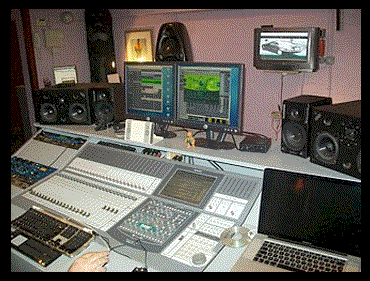
The Elephant House main room 
Things have changed out of all recognition in recording studios ... and especially over over the past decade. Stupidly cheap kit, free audio software and web distribution offer a great deal to musicians. We’re now seeing brilliant work emerging, some of it completely (and rightly) in the hands of the people who create it. It’s not easy, of course: doing all the marketing as well as all the creative work is hard.  But that's for another post.

Our changing times have led to the near-demise of the old-school recording studio. In some ways, it’s no bad thing. The big studios were preposterously expensive. But look around your town, and you'll find some inspiring surprises.

Back in the day, big studios let you put 70 people in a room and create big stuff. Once there were several in the region.  Now there’s only a few left in the country, and they survive on specialised work.
“Of course, everything’s changing now” explains Jon Cotton of Artisan Audio, “because anyone who’s got a laptop or an iPad has a recording studio in their hand.”
 Artisan, in Moseley, has built its reputation on fine albums from Scott Matthews, and through their production company Poseidon, the breathtaking work of Jo Hamilton, of which more below. Other work includes the soundtrack to the feature film 'Nativity' and TV soundtrack work. Like many local studios, they developed from small beginnings and ultimately (and ironically from a 21st century perspective) expanded through record company financing, when Jon’s band of the time, Gramophone, signed a deal with EMI Music.

Do you find that there is pressure to always have the latest wizzbang kit? And isn’t that still very expensive at the professional level?
“Well, we started off that way. Throughout the 90s it was a big selling point – we were (I think) the first studio in the Midlands to have Soundtools, the predecessor to Protools.  Nowadays it's less about the technology, more about having fantastic mics, preamps and outboard.  We’ve got used to hi-tec everywhere, even on our phones. But there came a point where we stopped pushing that aspect, because we, and our clients, pretty much take it for granted."
For a peek into one of Artisan's main rooms, with Jo Hamilton and band, take a look at this clip: 
"It’s more important to us nowadays that we can work quickly and reliably." Jon continues. "We’ve got all the latest and greatest tools for mixing, but past a certain point of sound quality, capturing the performance reliably is more important than chasing high-technology – it doesn't make the music better and sometimes just gets in the way.”
Home studio recording has changed things, and as we’ve said, it’s made life better in lots of ways. But I think a great hole has been hacked out of the studio world by new tech. And the big studios have taken the biggest hits.
“The only way you can get enough business to sustain the massive floor area you need for a big studio is to specialise. So things like orchestral recordings become your bread and butter. That’s happened in London. There are three studios – Angel, Air and Abbey Road, who get almost all the orchestral work, and most of the TV and Film business too. If you go there and do rock'n'roll, great… but that’s almost a sideline now.”
So where does that leave you – aren’t you being squeezed from both sides?
“We’re still offering the studio commercially, and it’s still very busy, a mix of external and Poseidon work.  We have some of Yo-Yo Ma's Silk Road Project coming in on Saturday.” 
Glad to hear it. What about your own creative projects?
"Our focus is Poseidon - our production company. A collection of really good people who really know how to use our tools.  Gear was always the bottleneck. You could only afford a posh studio if you had a record deal, so you could pay 120 grand for 8 weeks week in a top studio. There’s no longer a bottleneck there. So what it boils down to is ideas and craftsmanship; it's what you do with it. Anybody can afford the gear to make an amazing-sounding record. Gotye is a classic example. He’s just got 70 million views on YouTube, and he made that record with basically no gear in a shed.”

Brian.....                           ....and Rob
Over at Elephant House in Balsall Heath, Brian Nordhoff will see your Gotye and raise you… Flux Pavilion
"A 22-year old kid from a high-rise in Birmingham. Last year he did three tracks for will.i.am, and he’s done tracks for Jay-Z and Kanye WestSnoop Dogg phoned him up and he got annoyed… he’s ended up doing a track for Snoop Dogg!  It all started because Jay-Z heard his track on YouTube, and wanted to use it as a backing track. So they tracked him down, and used it. Then will.i.am heard it, and got in touch…"
And did you have any connection?
“It was part of Earl Falconer’s label, Circus, so I came to know about it through that. I just find it really encouraging.” 
One of Earl Falconer’s other non-UB40 projects is Dub Specimen. Their album was largely recorded at Elephant House, and it’s a beautiful album. It’s a taste of what Brian and Rob Cimarosti have worked on. Here's a track from the CD.
Elephant House is one of two production  houses in the area (the other is Friendly Fire Music), specialising in urban, dub and dancehall, and we’ll look at this in detail in a future post. But the studio Brian Nordhoff and Rob Cimarosti work from covers all sorts of different work. The afternoon I dropped by, DC Fontana were adding the final touches to parallel vocals for a new single: one version in Spanish and the other in English. 

Their studio started in the same way as Artisan.
“The Elephant House started because we had a band called Electribe 101. We thought it was dubby electronic stuff, but we were hailed as the forefront of British House. So we were on the front pages of NME, and we got enough money to build this place. We were initially signed to Phonogram, but we walked away…  insane record company politics. We’ve been independent ever since, apart from when we were signed to a company which was taken over by Sony… and the politics began all over again.  We were told the chief exec didn’t feel the album… so they were going to kill it.”
For a revealing account of their record company struggles, go to this page on the G-Corp website. G-Corp? That’s Groove Corporation, the band Electribe 101 morphed into. 
“It was a shame because the album was beautiful. It really annoyed me. We were showcasing six or seven local artists on it. It was everyone’s lives. It was a really nice piece of work. “
I'll second that. Here's a track to savour.
Co-Operation - Showtime
Licking their wounds, production work arrived…
“We built a reputation – ended up being asked to mix or produce some of the heroes of our youth, like Dillinger, Luciano, Big Youth…even Ennio MorriconeSly and Robbie. A lot of our heroes. I mixed Labour of Love for UB40”
Since then, you’ve just been beavering away in this studio? For over 20 years?
“Yes. We’ve never been great fans of fame, to be honest. For us it’s all about the music.  If we can make the music we want to make and pay the rent, great.” 
Are you paying the rent at the moment?
“Just about. But it’s very hard work. We used to sell a lot of records independently, but nobody buys records anymore, they just download them. A recent single,… we just had a look at two torrent sites. It had had 60,000 downloads. Which, if we’d been paid for, we’d have been very happy about. So we’re having to find new ways of doing things.” 
How can you deal with that?
“I don't know that you can. If a track is out there, it can travel. There’s two groups of people. There are some that don’t think too hard. They think everything should be free. But, seriously, tell that to your plumber the next time he comes round. We're going to lose a bed of independent music, because people can’t afford to make it anymore." 
But you give your music away for free when you dish out promo copies, you do free gigs for exposure… When are you in a position to control that, and get paid for your work?
“Live music. We go out with the Overproof Sound System, we do a lot of live work. I suppose as your reputation builds up, so you can command a decent fee.”
And sell your CDs at the gigs?
“Even that’s gone. You’re better off selling an mp3 bracelet.” 
Music’s become commoditised...
“Yeah. I realised the other day…a friend’s son came to me the other day and said I’ve got 8000 tracks on my iPod. So I said ‘What have you got?’ and he said 'Oh, a bit of this, and a bit of that, you know’… But nothing jumped out to him. It totally destroys the importance of music. You’re judged by the quantity of what you have, not by the quality."   
You’ve seen changes. You were one of the first white guys to get involved in reggae production. And that’s got really big in Birmingham. It’s really open and experimental.
“We’ve got a lot going on, without a doubt. But there's always been that black/white cultural mix. Look at Alex Sadkin, who produced Bob Marley and Black Uhuru. Or UB40. Or the house bands at Stax, Motown and Muscle Shoals. I grew up bathed in Reggae!” 
Who else have you got coming in to the Elephant House right now?
"Well at the moment we've put it all on one side - for us! We've got an Overprooof Sound System album to finish, we've got a new G-Corp album that's well overdue, that's got to get done. So unless people are begging us to get in here, we're going to try and get the next few months to ourselves. That's why we built this place originally - it was to do it for ourselves. But both Fontanas are back in at the moment - we've got Fontana Instincts (Folk./Blues/Psychedelia, from Derby), and DC Fontana..." 
All of which tells me that - sometime this summer -  I'll be posting about a lot of new work, when it sees the light of day. Can't wait. 

Links:
Artisan Audio/Poseidon
Elephant House/G-Corp


Sunday, 15 January 2012

The Destroyers cross the PledgeMusic finish line

How one band found online fan funding to support their CD. It wasn't easy...

Louis Robinson in make-up for the video shoot
On January 12th 2012, around lunchtime, the Destroyers hit their target on PledgeMusic.com.

This allowed them to fund the release of their second album. I am delighted for them. I’m not alone: check the Destroyers' Facebook page to read messages of congratulations from all over.

By the way, this here is Louis Robinson with a lot of scary make-up being applied. The Destroyers were shooting a video yesterday for their next single. More on this later.

I’m a big fan. I’d love to see the band grow and prosper.  I’ve been watching the online pledge process closely from the moment they got it underway. It seems to me that the Destroyers played this one just right. But setting up a worthwhile project on one of the many pledge sites is one thing; taking it to fruition is quite another. 

Fan-funded music releases aren’t new. Ten years ago, veteran Scottish pomp-rockers Marillion demonstrated the power of marketing themselves directly to a loyal Europe-wide fan base with spectacular success, when the record industry had long since written them off. Buffalo singer-songwriter Anni DiFranco has put out releases yearly for 18 years on her own label, maintaining and managing direct links to her growing following.


And it’s becoming a much more significant part of the music landscape. I went to PledgeMusic  to look at the successes. On the Funded - that is, successful – page today, the Destroyers are up there, front and centre, one of the most recent projects to cross the finish line. Following on are a string of happily completed projects from around the world. You won’t know most of them, because they all successfully work to their home areas. But if you jump back to the PledgeMusic home page you’ll see some surprisingly big names, not all of whom have been successful. Many are: there’s Reef, and Killing Joke, who have both wildly exceeded their targets, and in so doing, sidestepped the conventional record industry to great effect. But look – here’s Ian McCullough, a name to conjure with from the 70s and 80s, who has yet to hit the 100% mark. I think he probably will – he’s three quarters of the way there and he still has another two months to gather the remaining pledges of support.

Pledge sites work by inviting fans to contribute towards a total sum. This funds a CD, or a DVD, or a film, or an EP, or an artistic activity. There are dozens of such sites covering all sorts or artistic activities, but they tend to work in much the same way: your pledges are only redeemed if the entire project hits its target. So there is a risk of failure. And of course, if you fail, your failure is both public and extremely disappointing for the band and fans.

When the Destroyers kicked their campaign off late last year, they rapidly hit the 30% pledge mark,  offering a range of goodies to pledge for from straight downloads to signed items, and even attendance at a rehearsal followed by dinner with the band at a mere £140. This is a bargain: you have to fork out 500 Australian dollars for dinner with The Murphy Brothers, a three piece from Western Australia. After that encouraging start, things slowed down a little bit. Then, alarmingly, things slowed down quite a lot. The percentage total, loping gently but steadily upwards, started to crawl. And after Christmas, for obvious reasons, things got sticky. With a week to go, they were still some 20% off their target. However, recent days saw an explosion of online activity to raise awareness. Band members, friends, fans, family and fellow musicians, tweeted, posted and nagged. The band kept up a steady stream of posts, offering video clips and extra treats for those who had already pledged. I wasn't sure anyone eventually came in for Louis Robinson’s framed beard, though - a snip at £69. 

I met with the band at their video shoot (in a backstreet boozer a stone's throw from the Birmingham markets area) to talk over their campaign.Louis  was more than happy with Pledgemusic: 
“They get involved. You talk to them at least once a week, and it’s always the same person, so you develop a relationship. They’ll tell you about other campaigns on their site, and suggest you try this or that.”

It looked at one time that you weren’t going to hit your target. Do you think you were realistic in setting your financial goal?

“Yes. We weren’t asking for a huge amount – enough to press up a few thousand CDs, cover some mixing costs and bits and pieces. The bigger your following, the more you can aim for. But Pledgemusic are also pretty good at suggesting a realistic target. And they check you out before letting you sign up – they look at your site, see how many Facebook likes you have see, listen to your music, read the reviews…”

Louis, you still have your beard. Didn’t anyone pledge for it?

“Oh, they did. There will be a ceremonial presentation. There may be video footage in due course...."
Isn't there the awful risk that you might actually fail in your attempt to raise funds? I saw an awful lof of low percentage pledges on PledgeMusic...
"Yes, there is that risk, and we were well aware of it as we approached the deadline day. But PledgeMusic, like I said, were, extremely helpful in suggesting strategies."

Paul Murphy and Sam Wooster (trumpet) talked about the dog days of the campaign.

Sam: “When we got to about 60% of our target, with two weeks to go, I was a bit worried. But then it all came together. We got everyone working their own social networks - lovers, families, friends...”

Maybe your timing could have been better? You hit the slow stage right after Christmas, when everyone was flat broke. It was a bit touch and go there for a while...

Paul: “Robin, we really didn’t have a lot of choice. In planning the album release, tours for this coming year, a first single (Hole In The Universe), and everything else, this was how it had to be. But so many people came onboard with our last minute campaign, by posting and tweeting about us, it spread the word further. And we were able to offer a few exclusive goodies to our pledgers – so that helped.”

And with that, it was back to the video shoot. They were running late, of course. Here's the result:


Lessons learned?
Think it through. Design a campaign. Get your project up. And then sell it, hard, repeatedly, and shamelessly. Find angles. Enlist support. Get the project to go viral if you can. As with so much of today’s music industry, the onus comes back down to the artist. Your fans may love you to pieces, but your job is to convince them to part with money online. To many, that’s a contradiction in terms. And remember that you are in competition with dozens of equally deserving projects, some of whom will be by people you know. The day I went down to meet with the band, two more fan-funded appeals landed in my email inbox. I suggest you take a look at the freshly launched appeal project on WeFund.com from the wonderful Wes Finch. (Update: this project has now hit is funding target too)

By the way, if you’re nosing around Balsall Heath, and you just happen to spot a very battered and tarnished Tuba, Mark Davis would like it back, please. He only put it down for a second, went back inside, and came back to find it gone. Maybe the scrap metal boys came down his street while his back was turned. Now, it may only have cost £20 and a bit of elbow grease to convert it back to from its function as a plant pot; it may not have a perfectly brilliant tone. But it’s the Destroyers’ tuba, dammit, and they want it back.

My congratulations go to the whole band. Now, where’s my CD download?

See also
Scoring big national airplay: how two local bands did this