I hear local mutterings, and ruffling of feathers. Big bad Wireless Festival is coming to Brum. Get real - this is serious business, and we should get a slice.
The Largest Music Promoters In The UK, Live Nation, are plonking their flagship brand, Wireless Festival, down in Birmingham this summer. Two simultaneous festivals rotating line-ups between London and Brum over three days. This makes it, by a long chalk the biggest music event in the city: 150,000 paying customers in Perry Park over three days. This happened without the knowledge or involvement of anyone involved in any of the well-meaning council-sponsored or other bodies trying to push the local music scene forward. Fait accompli, done deal, we're coming, thank you very much. That's business So is this a bad thing? I don't really think so. It's how the music industry operates when it's set up to run on an industrial scale. And maybe we should think about building links. The big boys don't need us and our local scene. But we could sure do with touting our wares on a big stage. And there are grounds for optimism.
Why does a double MOBO winner, known and respected the world over, come back to work on a day of music activities in a grotty underpass in an unpreposessing part of town, hauling some extremely major names in to play… five years in a row?
The Flyover Show is the most unlikely success story. Birmingham offers several festivals where the music and culture centres around reggae and the music that has grown from reggae – Reggae City, Simmer Down… and The Flyover Show. All of them are open, welcoming and friendly; none of them get the press coverage they deserve; all of them pull typically mixed Birmingham reggae crowds. But The Flyover Show has been going the longest. It’s even travelled abroad to South Africa, with a Flyover Show held this year in Sowetoitself.
Soweto Kinch lives in Hockley, Birmingham. Feet squarely on the ground, informed, self-aware, articulate, open and positive, he sees The Flyover Show’s location in Hockley as an essential part of the whole exercise. And to achieve that end, he gives of himself to an extraordinary degree.
“We get so much bad press. The only time these areas get spoken about is as ‘high centres of unemployment, race riots, knife crime, gun crime… I really want to do a re-branding exercise, not just for the outside world, but for ourselves.”
Last year, at The 2011 Flyover Show, I watched him work HARD, in the middle of the afternoon, operating without a PA, while the generator was repaired. He was compere, cheerleader and animateur, bigging up, encouraging, cajoling and celebrating, right in the thick of it down among the crowd. Then when the stage PA crackled into life, just in time for some of the name acts, he was up, jamming, supporting, gliding though music styles with grace and ease. It was deeply impressive stuff.
This isn’t your regular music get together. It belongs to, and is explicitly part of, Hockley. So it’s a bit more of a community fete, only with added megastars. This year, Maxi Priest, Janet Kay, Julian Joseph, joining with Basil Gabbidon, Soweto himself, Lady Leshurr, Dec14Life, RTKaland more.
There’s, of course, a clear Jamaican flavour to The Flyover Show this year. Monday 6th August marked the 50th anniversary of Jamaican independence, and celebrations are taking place across the country. Given that the West Midlands has the second highest concentration of UK Jamaicans, and that Hockley sits squarely between Aston, Lozells and Handsworth, that’s a further reason to continue to develop and promote the show in its very specific location.
And given the passing of time, it’s now a generational thing. A couple of years ago, I put together an affectionate if slightly rose-tinted radio documentary, Handsworth Evolution, in which I talked with at the generations of Jamaican and Jamaican-inspired musicians who have lived and worked in Birmingham since the end of the war. Taking the late Andy Hamilton as the first generation, Steel Pulse, Ruby Turner and UB40 as the second generation, that places Soweto as part of the 3rd generation. And it’s clear he wants to encourage that same pride and creativity shown by the first three generations in the fourth generation. But of course it’s a long way from Calypso, Rock Steady, Blue Beat and Ska, to the present day, and as always happens, a whole host of other music influences and directions have added to the mix.
A People With No Past From Soweto Kinch's 2011 New Emancipation album So of course things have changed and developed. But do you feel that over the past nearly seventy years, that there has been a dilution in Jamaican music and culture?
“No, I wouldn’t describe it as dilution at all. It’s an evolution. Identity and culture are not static concepts. We’re all dealing with what globalisation means to us; all reassessing what ideas like ‘Britishness’ are like – are they redundant as terms when we’ve got such a heterogeneous population? For me, consistently, Jamaica has provided more than just a place to associate with… but a kind of attitude that’s embodied in the people. As Usain Bolt says (as he beats his chest crossing the finishing line), we’re a small island with a big heart.”
“There are so many islands across the West Indies, but for some reason, Jamaica seems to shout loudest above the rest. That may be criticised by the other islands, but it’s something to be commended in this country, when we’ve had to deal with so much virulent racism. That fighting spirit has left an indelible mark on this country, and certainly on me.”
OK, evolution it is. But where does, say Wordsworth MC– he’s from Brooklyn – place himself?
“It would be impossible for Wordsworth to do what he does with the influence of Jamaica and Jamaican culture. As a Brooklyner, as that kind of MC – it’s completely flavoured with West Indian inflections and Sound system culture. As an MC, growing up in New York, you have to be aware of that tradition. That morphs, wherever you go in the world.”
Pogus Caesar's shot of Soweto Kinch, 2010
“That’s a great thing – it gets you thinking about the tendrils of Jamaican culture. Not just some jerk chicken on the beach. Escaping some of those stereotypes, you realise it’s had a far more profound influence on the way we all think, the way we all approach music now. So it’s a great time for us to consider how that culture has changed, how is it different from, you know, after the Empire Windrush to now.”
Given that huge span of culture and interactions, how easy is it to put a bill together?
“It’s great having these themes to tie things down to. To be able to have jazz alongside hip-hop, alongside spoken word, alongside dance (there’s a specially commissioned dance from Birmingham Royal Ballet), alongside an out and out reggae artist… there is a common thread tying them all together.”
You’re growing all the time. Will you come back to Hockley Flyover next year? There’s only so much space there…
“Yeah. Absolutely. I would love to. I think what’s really symbolic and important about this show is that it has a grass-roots identity. The work and the stories from that community that never get celebrated, that never really earn the same respect – it’s always ‘community arts’, the poor cousin of high art – that work still needs to go on. And if it just gets too big, we’ll build a bigger flyover!”
Links: The Flyover Show site The Flyover Show South Africa site Soweto Kinch's site Hockley Circus Birmingham on Google maps
In between laptop kids and big budget operations, music studios are diversifying to survive. Two local operators, doubling as production houses, 'fess up...
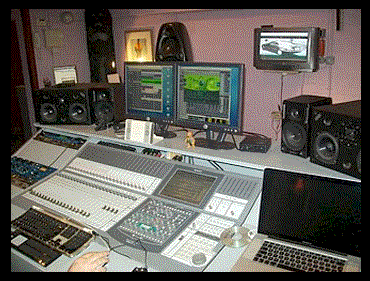
The Elephant House main room
Things have changed out of all recognition in recording studios ... and especially over over the past decade. Stupidly cheap kit, free audio software and web distribution offer a great deal to musicians. We’re now seeing brilliant work emerging, some of it completely (and rightly) in the hands of the people who create it. It’s not easy, of course: doing all the marketing as well as all the creative work is hard. But that's for another post.
Our changing times have led to the near-demise of the old-school recording studio. In some ways, it’s no bad thing. The big studios were preposterously expensive. But look around your town, and you'll find some inspiring surprises.
Back in the day, big studios let you put 70 people in a room and create big stuff. Once there were several in the region. Now there’s only a few left in the country, and they survive on specialised work.
“Of course, everything’s changing now” explains Jon Cotton of Artisan Audio, “because anyone who’s got a laptop or an iPad has a recording studio in their hand.”
Artisan, in Moseley, has built its reputation on fine albums from Scott Matthews, and through their production company Poseidon, the breathtaking work of Jo Hamilton,of which more below. Other work includes the soundtrack to the feature film 'Nativity' and TV soundtrack work. Like many local studios, they developed from small beginnings and ultimately (and ironically from a 21st century perspective) expanded through record company financing, when Jon’s band of the time, Gramophone, signed a deal with EMI Music.
Do you find that there is pressure to always have the latest wizzbang kit? And isn’t that still very expensive at the professional level?
“Well, we started off that way. Throughout the 90s it was a big selling point – we were (I think) the first studio in the Midlands to have Soundtools, the predecessor to Protools. Nowadays it's less about the technology, more about having fantastic mics, preamps and outboard. We’ve got used to hi-tec everywhere, even on our phones. But there came a point where we stopped pushing that aspect, because we, and our clients, pretty much take it for granted."
For a peek into one of Artisan's main rooms, with Jo Hamilton and band, take a look at this clip:
"It’s more important to us nowadays that we can work quickly and reliably." Jon continues. "We’ve got all the latest and greatest tools for mixing, but past a certain point of sound quality, capturing the performance reliably is more important than chasing high-technology – it doesn't make the music better and sometimes just gets in the way.”
Home studio recording has changed things, and as we’ve said, it’s made life better in lots of ways. But I think a great hole has been hacked out of the studio world by new tech. And the big studios have taken the biggest hits.
“The only way you can get enough business to sustain the massive floor area you need for a big studio is to specialise. So things like orchestral recordings become your bread and butter. That’s happened in London. There are three studios – Angel, Air and Abbey Road, who get almost all the orchestral work, and most of the TV and Film business too. If you go there and do rock'n'roll, great… but that’s almost a sideline now.”
So where does that leave you – aren’t you being squeezed from both sides?
“We’re still offering the studio commercially, and it’s still very busy, a mix of external and Poseidon work. We have some of Yo-Yo Ma's Silk Road Project coming in on Saturday.”
Glad to hear it. What about your own creative projects?
"Our focus is Poseidon - our production company. A collection of really good people who really know how to use our tools. Gear was always the bottleneck. You could only afford a posh studio if you had a record deal, so you could pay 120 grand for 8 weeks week in a top studio. There’s no longer a bottleneck there. So what it boils down to is ideas and craftsmanship; it's what you do with it. Anybody can afford the gear to make an amazing-sounding record. Gotye is a classic example. He’s just got 70 million views on YouTube, and he made that record with basically no gear in a shed.”
"A 22-year old kid from a high-rise in Birmingham. Last year he did three tracks for will.i.am, and he’s done tracks for Jay-Z and Kanye West. Snoop Dogg phoned him up and he got annoyed… he’s ended up doing a track for Snoop Dogg! It all started because Jay-Z heard his track on YouTube, and wanted to use it as a backing track. So they tracked him down, and used it. Then will.i.am heard it, and got in touch…"
And did you have any connection?
“It was part of Earl Falconer’s label, Circus, so I came to know about it through that. I just find it really encouraging.”
One of Earl Falconer’s other non-UB40 projects is Dub Specimen. Their album was largely recorded at Elephant House, and it’s a beautiful album. It’s a taste of what Brian and Rob Cimarosti have worked on. Here's a track from the CD.
Elephant House is one of two production houses in the area (the other is Friendly Fire Music), specialising in urban, dub and dancehall, and we’ll look at this in detail in a future post. But the studio Brian Nordhoff and Rob Cimarosti work from covers all sorts of different work. The afternoon I dropped by, DC Fontana were adding the final touches to parallel vocals for a new single: one version in Spanish and the other in English.
Their studio started in the same way as Artisan.
“The Elephant House started because we had a band called Electribe 101. We thought it was dubby electronic stuff, but we were hailed as the forefront of British House. So we were on the front pages of NME, and we got enough money to build this place. We were initially signed to Phonogram, but we walked away… insane record company politics. We’ve been independent ever since, apart from when we were signed to a company which was taken over by Sony… and the politics began all over again. We were told the chief exec didn’t feel the album… so they were going to kill it.”
For a revealing account of their record company struggles, go to this page on the G-Corp website. G-Corp? That’s Groove Corporation, the band Electribe 101 morphed into.
“It was a shame because the album was beautiful. It really annoyed me. We were showcasing six or seven local artists on it. It was everyone’s lives. It was a really nice piece of work. “
“We built a reputation – ended up being asked to mix or produce some of the heroes of our youth, like Dillinger, Luciano, Big Youth…even Ennio Morricone… Sly and Robbie. A lot of our heroes. I mixed Labour of Love for UB40”
Since then, you’ve just been beavering away in this studio? For over 20 years?
“Yes. We’ve never been great fans of fame, to be honest. For us it’s all about the music. If we can make the music we want to make and pay the rent, great.”
Are you paying the rent at the moment?
“Just about. But it’s very hard work. We used to sell a lot of records independently, but nobody buys records anymore, they just download them. A recent single,… we just had a look at two torrent sites. It had had 60,000 downloads. Which, if we’d been paid for, we’d have been very happy about. So we’re having to find new ways of doing things.”
How can you deal with that?
“I don't know that you can. If a track is out there, it can travel. There’s two groups of people. There are some that don’t think too hard. They think everything should be free. But, seriously, tell that to your plumber the next time he comes round. We're going to lose a bed of independent music, because people can’t afford to make it anymore."
But you give your music away for free when you dish out promo copies, you do free gigs for exposure… When are you in a position to control that, and get paid for your work?
“Live music. We go out with the Overproof Sound System, we do a lot of live work. I suppose as your reputation builds up, so you can command a decent fee.”
And sell your CDs at the gigs?
“Even that’s gone. You’re better off selling an mp3 bracelet.”
Music’s become commoditised...
“Yeah. I realised the other day…a friend’s son came to me the other day and said I’ve got 8000 tracks on my iPod. So I said ‘What have you got?’ and he said 'Oh, a bit of this, and a bit of that, you know’… But nothing jumped out to him. It totally destroys the importance of music. You’re judged by the quantity of what you have, not by the quality."
You’ve seen changes. You were one of the first white guys to get involved in reggae production. And that’s got really big in Birmingham. It’s really open and experimental.
“We’ve got a lot going on, without a doubt. But there's always been that black/white cultural mix. Look at Alex Sadkin, who produced Bob Marley and Black Uhuru. Or UB40. Or the house bands at Stax, Motown and Muscle Shoals. I grew up bathed in Reggae!”
Who else have you got coming in to the Elephant House right now?
"Well at the moment we've put it all on one side - for us! We've got an Overprooof Sound System album to finish, we've got a new G-Corp album that's well overdue, that's got to get done. So unless people are begging us to get in here, we're going to try and get the next few months to ourselves. That's why we built this place originally - it was to do it for ourselves. But both Fontanas are back in at the moment - we've got Fontana Instincts (Folk./Blues/Psychedelia, from Derby), and DC Fontana..."
All of which tells me that - sometime this summer - I'll be posting about a lot of new work, when it sees the light of day. Can't wait. Links: Artisan Audio/Poseidon Elephant House/G-Corp