Monday, 12 March 2012

Four club DJs - Sam Redmore, Marc Reck, DJ Switch and Karl Jones - talk. Off-mic, of course.

Hang the DJ! Oops, wrong century. Then, DJs were radio beasts, sometimes supporting music they believed in. Now, with a few exceptions, that role sits with club DJs.  

Photo courtesy djswitchbeatz..co.uk
What does the term DJ actually mean? I asked that in a radio workshop last week. Nobody thought it had much to do with radio; it was all about clubbing. 

The term DJ – originally, short for ‘Disk Jockey’ – has been around for nearly 80 years. It was never meant to be flattering, allegedly coined by a US Network News giant to describe a continuity announcer who happened to have an on-air records show.  My first mentor, the great Jim Santella, still on air at WBFO in Buffalo, New York after 40 years, described Radio DJing as ‘pimping on other people’s reflected glory’, and there’s a lot of truth in that. 

Now,  DJs with actual discs are pretty rare. And you could say there are few, if any, pure DJs in radio now. They’re presenters or talent. Or... pre-recorded voice links. 

Some things don't change. DJs are still overwhelmingly male, and there's a LOT of unjustified ego flying around. But today’s DJ is far more likely to work in studios or clubs, interacting directly and immediately with live audiences. Critically, Club DJs can also produce their own music and increasingly, they collaborate creatively with musicians.  I talked with four of Birmingham’s finest for this post. 

Sam Redmore has made a name for himself at Leftfoot and his Moseley Freestyle nights, and bangs out both inventive short treatments of songs, and some sterling extended mixes. Expanding Freestyle into a live music event has given the event a massive boost. He recently remixed Chris Tye's 'New York City Rain' single, which you can find below, along with links to some extraordinary other work, rooted in his respect for his original sources of inspiration.


Photo: Pit Photography
Karl Jones, aka Malicious DJ, played a critical role in bridging live music and dj work when he embarked on the discussions that led to the forming of Alternative Dubstep Orchestra. Karl remains a part of ADO, as well as the Brotherhood of Filth. Karl also does a lot of brand new work. There's several links to some of Karl's work down the post.


Phto courtesy DJ Switch website
DJ Switch is three time DMC World DJ Champion, the first DJ to play at the BBC Proms at the Albert Hall last year. He's also part of the Brotherhood of Filth, and an early member of the ADO collective. Again, there's clips and links further down the post. 
Photo: Rob Nicholas
And Marc Reck (DJ Narrative) has waaay too many projects on to describe fully… but they’re all interesting. 

This post has partly came about though lengthy chats Marc and I had about how the worlds of Radio and Club could work together, when we both worked in our different ways on Project X Presents. I'm still not sure they can, but Marc has some enterprising approaches, discussed below, as do all the DJs featured here. Check his website….  and see the links below


So give me a definition of a DJ….? 
Sam Redmore: He’s the guy who plays the music in a club! But it’s not the time you spend with the people on front of you, it’s finding the music in the first place.
Marc Reck: There's different kinds… someone who plays & manipulates recorded material to create something else - an atmosphere or collective experience - or a radio show, a mixtape, an audio journey… 
DJ Switch: It’s interesting that people resist calling DJs 'musicians', and this extends to DJs themselves. The exception is turntablism. 
Karl Jones: A DJ is there to musically educate and bridge the gap between the recording artists and the general public, whilst maintaining the desired atmosphere and feeling required for the event or show with the correct track selection and mixing techniques.
What’s more important: the creativity of the mix or the live audience? How responsible do you feel to your audience?
KJ: If the crowd is right I feel like I should be paying to see them. I feel a responsibility to share good music, to share the reaction and see what reaction it brings out. Good music is like a good joke. I build my sets up from one liners to knock knocks before dropping in some classic gems. It’s vital the DJ remembers he’s there to entertain the crowd and not just himself.
MR: I think the mix and the audience are equally important. Ultimately the audience's experience comes first. I've seen people talk about how cutting edge or uncompromising their musical taste is, and then see them clear a diverse party crowd dance floor. The great DJs are ones that can, in front of any audience, keep the whole place up and do something creative or unique.
MR: The reason I started DJing was to share music. Probably the biggest thing for me is to play a song that I love, and see people enjoying it. 
DJS: Audience, definitely. There's no sense in doing something mind-boggingly creative if the people you're doing it for can't appreciate it on some level. But don't take that to mean ruling out creativity by any stretch.
There’s some interesting developments going on with all of you: longer mixes, which ‘feel’ like conventional radio shows, except that you’re not talking… it’s interesting to follow the flow of ideas 
SR: I guess you could say that. They tend to have a beginning, a middle and end, and the different styles of music represent plot twists. I like them to feel like they're always going somewhere.
KJ: People love to hear tracks they know and love, but when they don’t see them coming they seem to love them a whole lot more. With the software now available you can now put out any sound you have, instantly. That makes for speed and flexibility of expression – it’s much easier than ever before.
MR: I love the creativity that samples, binaural recordings, fx, and technology offer; how you can juxtapose these with music. It’s what made me learn turntablism and get into midi controllers. My first creative attempts at Narrative (DJ Narrative) were probably with the Fear & Love mix cd in 2006. Adapting the idea to performances made me find new ways to organise and play my music and sample library for maximum live DJ flexibility.
DJS: I often work with Bass6, who heads up the beatbox community and is one of the most energetic hosts you'll see. And, wonderfully, when he's not there, I have his intros & outros recorded from one of our joint live sets. If I don't use his voice, it's someone else's intro which I nabbed. I make sure I can intro myself if there's an MC there or not. 
A Radio DJ hopes that his or her show is listened to, but he or she can never really know. Radio listeners may let you into their lives, but you’re gone in a flash when it’s time to feed the cat or answer the phone. A live audience, on the other hand, tells you straight if it likes you or not. So if, at its peak, the essence of DJing these days is about working with an audience, and seeing where the collective mood takes you (and everyone else), it’s no wonder that for so many DJs, the club DJ experience completely eclipses the radio DJ experience. Smaller audiences, certainly… but they’re right there, in the flesh, and they talk back.

Best Live moment?   
MR: So many for different reasons... the first Project X, playing with 3 music stages, and an unforgettable vibe… the 2nd one for the string quartet & really exploring narrative via the Heroes Journey. All the Mr Elephant events for the diversity and interactivity. Birmingham Opera for the what it opened up for me musically. Shambala in the rammed out Kamikaze tent was incredible. Oh and the custom made events! - Especially the 2nd one which led to the Night times collaborations, and their very kind awards and gig of the year review. 
KJ: Performing alongside DJ Switch at a secret venue in London. 6hrs of non stop madness! I don’t think any record played for more than 1min.
SR:Tough to choose, but one that stands out was at the Garden Festival in Croatia a couple of years ago. Just as the sun was setting I played one of my all-time favourite songs, Sebastien Tellier's "La Ritournelle". The crowd was really into it, and at the end of the track there was a round of applause - something I've never witnessed during a DJ set before (apart from at the end of a set / night).
DJS: The first year I was at Glastonbury I closed the Shangri-La stage, which was epic. It was 4-5 am and pure ram-a-jam, the sun rose over the course of the hour and the crowd heaved like a single organism. That will stay with me forever. My 3rd DMC world title is definitely up there. It was the year I was most happy with performance-wise.
Just as with last week’s post, tech has completely transformed the tools a DJ has to play with. On the rare occasions I DJ these days, I take a laptop loaded with mp3s and play them out through the freebie version of  Virtual DJ, something most pro DJs might regard as little more than a toy. But any kit can let you down…

Worst moment?   
MR: Probably when the equipment fails just before the gig. A great example of where tech crew are legendary, sorting out the issue where there seems to be no solution. I’ve had a few times with promoters saying there’s enough space to setup… then finding there's none until your set, which can make smooth changeovers pretty tricky.  
SR: My laptop gave up on me one night at the Bull's Head. I managed to get one track going, but had to dash upstairs into the office where most of my records are kept and frantically try to pick out a few others that would work before the track that was playing ran out. The records are kind of scattered all over the place, so it's impossible to know where to look. I dread to think what I ended up returning with...
DJS: I got talked into trying out black cider one night, and ended up finishing off 4 bottles just before I started playing. I remember getting onto the decks and thinking "wow, my hands are a lot further away from my head than they usually are!" I don't think the set was that bad, but it's a moment that's kept me in check ever since. The promoter told me in the morning "oh I recorded your set last night" and I replied "never EVER play it back to me!"
KJ: Honestly......I’ve loved every single minute so far!
Personally, I’m particularly interested in how the intensity of the DJ’s performance with a live crowd could ever be ported into a radio show. It's like squaring a circle - you can get closer and closer, but you'll never get perfection.  I don’t really think you can achieve that perfection, any more than a live music show can completely transfer onto an audio file. 

So: do you think club mixing can work on radio (I don't, myself... but I’m open to persuasion)
SR: Well if by club mixing you mean extended DJ mixes, then definitely yes. It all depends on the DJ in question, but I've heard some great sets on things like the Radio 1 Essential Mix. It's no longer about interacting with the crowd in the same way that playing in a club to an audience is, more of a chance to showcase some great music and put it together in an interesting and creative way.
DJS: I don't see why not. I've always enjoyed going down to London and tuning in to Rinse down there. No idea who's playing but just vibing along to the tracks. I'm normally like that when I go into clubs anyways.
In terms of explanation, seeing the poster for the gig you go to gives you the context - it attracts your audience & tells you who's on. Radio has to give that context in some form - if it's not by listings, why not by announcer? Fills the same role as the MC at the gig.  Moderation...I was stunned by a recent act of censorship. I did a mix for 1Xtra last year and put in a track called "The Hip Hop War", which basically had a chorus going 'bredrin' and 'blud'. I think the mix went out at 9, the track came on and first they censored 'bredrin' - which was a bit stupefying - and then they cut out the rest of the track which had 'blud' in it. Considering the station carries quite a strong urban ethic in it’s' image, and they still took that rather bizarre step when the mix went out after the watershed, it felt very backward.
KJ: There is a place for continuous mixes to be played on air but on the whole I would rather learn something from what I’m hearing - not just learning if I like it or not. I want to know who it’s by? what’s their story? Radio taught me that music goes much further than just what you’re hearing. As a producer it’s great having your tracks played on air but it’s always better when somebody tells the listeners who it’s by and when it’s out etc. Radio without any dialogue is kinda like looking at the pictures of a comic but not reading the story, you miss out on half the enjoyment.  
MR:  I found that hosting the Mr Elephant Radio show (on Rhubarb Radio and elsewhere) as a whole mix with hosting presented different limitations. The goals were to share and promote the best new music while trying to represent where I was as a DJ. I found that the two don’t always mix. Hosting new records and connecting with the audience can take away from the mix itself. 
So my idea is to create a Dj Narrative Podcast. It launched last week. Among other things like tutorials and free tracks, it aims to share a well crafted mix but with narrative and no hosting, but labelled as either down tempo (or "Coming Home") and up-tempo / dance floor (or "Going Out"). I think  hosting isn’t something that people would really want to hear more than once. It's not really suitable for listening with friends, say. So I’m hoping the narrative side and the labels will help address the different times that people listen. I like the idea of putting it out as a newsletter & podcast so there can be more related content… but I’ve only just started. 
And that’s one of the critical areas. How do you, as a host, explain an emotion, a gut feeling, a burst of energy and inspiration, without ripping the guts out of it? My thanks to Marc Reck, Karl Jones, Sam Redmore and DJ Switch for their considered and patient answers to my questioning. There’s a lot more we all talked about, and some of it may emerge in a future post.

Now, here’s some more work from each DJ…

DJ Switch

"Generally when I put together routines, they start with an idea which a) excites me and b) I feel I can get a lot out of it. Here’s an example: 
The idea was to scratch the original sample on top of the final track. The audience are grooving when the beat drops, and I'm grooving by making a new chorus riff on top of it. It's melodic, and even if you're not sure what I'm doing, you still recognise the remix element."
There's a lot more at the DJ Switch website, including gig details.


Sam Redmore
Here’s Chris Tye's recent single 'New York City Rain' as remixed by Sam:
And here's a link to Sam's breathtaking SoundCloud pages.
And here's the Freestyle blog which carries gig details and more.


Karl Jones
Here's the Brotherhood of Filth SoundCloud pages
 

Marc Reck
Marc's  website  is here, including gig details and a great blog section

.


Monday, 5 March 2012

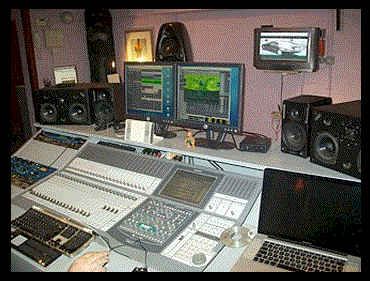
Artisan and Elephant House studios

In between laptop kids and big budget operations, music studios are diversifying to survive. Two local operators,  doubling as production houses, 'fess up... 
The Elephant House main room 
Things have changed out of all recognition in recording studios ... and especially over over the past decade. Stupidly cheap kit, free audio software and web distribution offer a great deal to musicians. We’re now seeing brilliant work emerging, some of it completely (and rightly) in the hands of the people who create it. It’s not easy, of course: doing all the marketing as well as all the creative work is hard.  But that's for another post.

Our changing times have led to the near-demise of the old-school recording studio. In some ways, it’s no bad thing. The big studios were preposterously expensive. But look around your town, and you'll find some inspiring surprises.

Back in the day, big studios let you put 70 people in a room and create big stuff. Once there were several in the region.  Now there’s only a few left in the country, and they survive on specialised work.
“Of course, everything’s changing now” explains Jon Cotton of Artisan Audio, “because anyone who’s got a laptop or an iPad has a recording studio in their hand.”
 Artisan, in Moseley, has built its reputation on fine albums from Scott Matthews, and through their production company Poseidon, the breathtaking work of Jo Hamilton, of which more below. Other work includes the soundtrack to the feature film 'Nativity' and TV soundtrack work. Like many local studios, they developed from small beginnings and ultimately (and ironically from a 21st century perspective) expanded through record company financing, when Jon’s band of the time, Gramophone, signed a deal with EMI Music.

Do you find that there is pressure to always have the latest wizzbang kit? And isn’t that still very expensive at the professional level?
“Well, we started off that way. Throughout the 90s it was a big selling point – we were (I think) the first studio in the Midlands to have Soundtools, the predecessor to Protools.  Nowadays it's less about the technology, more about having fantastic mics, preamps and outboard.  We’ve got used to hi-tec everywhere, even on our phones. But there came a point where we stopped pushing that aspect, because we, and our clients, pretty much take it for granted."
For a peek into one of Artisan's main rooms, with Jo Hamilton and band, take a look at this clip: 
"It’s more important to us nowadays that we can work quickly and reliably." Jon continues. "We’ve got all the latest and greatest tools for mixing, but past a certain point of sound quality, capturing the performance reliably is more important than chasing high-technology – it doesn't make the music better and sometimes just gets in the way.”
Home studio recording has changed things, and as we’ve said, it’s made life better in lots of ways. But I think a great hole has been hacked out of the studio world by new tech. And the big studios have taken the biggest hits.
“The only way you can get enough business to sustain the massive floor area you need for a big studio is to specialise. So things like orchestral recordings become your bread and butter. That’s happened in London. There are three studios – Angel, Air and Abbey Road, who get almost all the orchestral work, and most of the TV and Film business too. If you go there and do rock'n'roll, great… but that’s almost a sideline now.”
So where does that leave you – aren’t you being squeezed from both sides?
“We’re still offering the studio commercially, and it’s still very busy, a mix of external and Poseidon work.  We have some of Yo-Yo Ma's Silk Road Project coming in on Saturday.” 
Glad to hear it. What about your own creative projects?
"Our focus is Poseidon - our production company. A collection of really good people who really know how to use our tools.  Gear was always the bottleneck. You could only afford a posh studio if you had a record deal, so you could pay 120 grand for 8 weeks week in a top studio. There’s no longer a bottleneck there. So what it boils down to is ideas and craftsmanship; it's what you do with it. Anybody can afford the gear to make an amazing-sounding record. Gotye is a classic example. He’s just got 70 million views on YouTube, and he made that record with basically no gear in a shed.”

Brian.....                           ....and Rob
Over at Elephant House in Balsall Heath, Brian Nordhoff will see your Gotye and raise you… Flux Pavilion
"A 22-year old kid from a high-rise in Birmingham. Last year he did three tracks for will.i.am, and he’s done tracks for Jay-Z and Kanye WestSnoop Dogg phoned him up and he got annoyed… he’s ended up doing a track for Snoop Dogg!  It all started because Jay-Z heard his track on YouTube, and wanted to use it as a backing track. So they tracked him down, and used it. Then will.i.am heard it, and got in touch…"
And did you have any connection?
“It was part of Earl Falconer’s label, Circus, so I came to know about it through that. I just find it really encouraging.” 
One of Earl Falconer’s other non-UB40 projects is Dub Specimen. Their album was largely recorded at Elephant House, and it’s a beautiful album. It’s a taste of what Brian and Rob Cimarosti have worked on. Here's a track from the CD.
Elephant House is one of two production  houses in the area (the other is Friendly Fire Music), specialising in urban, dub and dancehall, and we’ll look at this in detail in a future post. But the studio Brian Nordhoff and Rob Cimarosti work from covers all sorts of different work. The afternoon I dropped by, DC Fontana were adding the final touches to parallel vocals for a new single: one version in Spanish and the other in English. 

Their studio started in the same way as Artisan.
“The Elephant House started because we had a band called Electribe 101. We thought it was dubby electronic stuff, but we were hailed as the forefront of British House. So we were on the front pages of NME, and we got enough money to build this place. We were initially signed to Phonogram, but we walked away…  insane record company politics. We’ve been independent ever since, apart from when we were signed to a company which was taken over by Sony… and the politics began all over again.  We were told the chief exec didn’t feel the album… so they were going to kill it.”
For a revealing account of their record company struggles, go to this page on the G-Corp website. G-Corp? That’s Groove Corporation, the band Electribe 101 morphed into. 
“It was a shame because the album was beautiful. It really annoyed me. We were showcasing six or seven local artists on it. It was everyone’s lives. It was a really nice piece of work. “
I'll second that. Here's a track to savour.
Co-Operation - Showtime
Licking their wounds, production work arrived…
“We built a reputation – ended up being asked to mix or produce some of the heroes of our youth, like Dillinger, Luciano, Big Youth…even Ennio MorriconeSly and Robbie. A lot of our heroes. I mixed Labour of Love for UB40”
Since then, you’ve just been beavering away in this studio? For over 20 years?
“Yes. We’ve never been great fans of fame, to be honest. For us it’s all about the music.  If we can make the music we want to make and pay the rent, great.” 
Are you paying the rent at the moment?
“Just about. But it’s very hard work. We used to sell a lot of records independently, but nobody buys records anymore, they just download them. A recent single,… we just had a look at two torrent sites. It had had 60,000 downloads. Which, if we’d been paid for, we’d have been very happy about. So we’re having to find new ways of doing things.” 
How can you deal with that?
“I don't know that you can. If a track is out there, it can travel. There’s two groups of people. There are some that don’t think too hard. They think everything should be free. But, seriously, tell that to your plumber the next time he comes round. We're going to lose a bed of independent music, because people can’t afford to make it anymore." 
But you give your music away for free when you dish out promo copies, you do free gigs for exposure… When are you in a position to control that, and get paid for your work?
“Live music. We go out with the Overproof Sound System, we do a lot of live work. I suppose as your reputation builds up, so you can command a decent fee.”
And sell your CDs at the gigs?
“Even that’s gone. You’re better off selling an mp3 bracelet.” 
Music’s become commoditised...
“Yeah. I realised the other day…a friend’s son came to me the other day and said I’ve got 8000 tracks on my iPod. So I said ‘What have you got?’ and he said 'Oh, a bit of this, and a bit of that, you know’… But nothing jumped out to him. It totally destroys the importance of music. You’re judged by the quantity of what you have, not by the quality."   
You’ve seen changes. You were one of the first white guys to get involved in reggae production. And that’s got really big in Birmingham. It’s really open and experimental.
“We’ve got a lot going on, without a doubt. But there's always been that black/white cultural mix. Look at Alex Sadkin, who produced Bob Marley and Black Uhuru. Or UB40. Or the house bands at Stax, Motown and Muscle Shoals. I grew up bathed in Reggae!” 
Who else have you got coming in to the Elephant House right now?
"Well at the moment we've put it all on one side - for us! We've got an Overprooof Sound System album to finish, we've got a new G-Corp album that's well overdue, that's got to get done. So unless people are begging us to get in here, we're going to try and get the next few months to ourselves. That's why we built this place originally - it was to do it for ourselves. But both Fontanas are back in at the moment - we've got Fontana Instincts (Folk./Blues/Psychedelia, from Derby), and DC Fontana..." 
All of which tells me that - sometime this summer -  I'll be posting about a lot of new work, when it sees the light of day. Can't wait. 

Links:
Artisan Audio/Poseidon
Elephant House/G-Corp


Sunday, 26 February 2012

Urban Folk Quartet; TG Collective. Two GREAT bands. Folk, Jazz, Latin, World. Your call.

New CDs launching this and next month. Shared musicians and connections. Academic rigour, passion and skill. 
New nujazzfolk albums abound in Birmingham this spring. They’re all different, but with common threads. The musicians all work with each other, for a start. Tracking who plays where is bewildering. It’s musical promiscuity of the highest order, and as always with promiscuous behaviour – let’s put this delicately - cross pollination will take place. I think I’ll stop exploring that analogy any further before I get into trouble. 

Both bands here are as much into Jazz as they are Folk. The key is experimentation, adventure, and a lot of fun on the side. The danger is that we take this brave and appealing work for granted. Please, don’t ever do that. Savour it; appreciate it, support it if you like; but don’t take it for granted.  


Urban Folk Quartet
UFQ: Broughton, Trigas, Moon and Chapman
Less than three years ago, UFQ – short for Urban Folk Quartet - didn’t officially exist. Three albums on, they’re one of the guvnor UK folk bands. They set a fearsome standard, effortlessly winning must-book status on folk and festival circuits across the UK and Europe. Teaching forms a large part of their background, the widest of wide musical experiences another, jaw-dropping technical skills a third, and genial enthusiasm and experimentation a fourth. 

I caught their first two gigs – opening for Jo Hamilton at the Glee Club in Birmingham City centre, and their official lunch at the Cross in Moseley. Both were lovely, musicianly, powerful, confident affairs. I loved them, but I wondered then how they would fare. I didn’t have to worry. For a brand new operation, they’ve done really rather well…

“We were quite careful about when we became a brand new operation”, explains UFQ cajonista Tom Chapman. “We probably did a little bit more prep and rehearsal before we started gigging. After our first Birmingham gigs, we headed out to Belgium, Spain and Italy. It’s always been part of the ethos of the band to try and get work abroad. With Joe and Paloma s' histories, having travelled widely and built up some ready made connections, that’s how that part of things came together”. 

It doesn’t hurt that they’re well connected. Joe Broughton teaches at Birmingham Conservatoire, of which more later, and he and Paloma Trigas teach at the Guildhall School in London. Tom also works with Joe for Music For Youth, and at the Barbican in London. So there is a certain academic cast to the band. Frank Moon, the fourth member of the band also teaches, has probably played in more bands in Birmingham than anyone else (of course, maybe you know better) .and is an examiner; and they all teach workshops too.
“Joe and I do a workshop called Folkworld in Devon, which is rather fun. Joe led a group at the Last Night of the School proms, with Music For Youth. They let me play cowbell…  The workshops are all about live music and getting kids going, getting them really excited about music. We don’t use any notated music at all. No music stands… everyone’s standing up ”
Tom’s background includes the excellent Old Dance School, who are also about to release a new CD, and session work with Katrina Gilmore and Jamie Roberts, TG Collective… and a lot of jazz. In fact, many of the nufolk musicians I’ve talked to recently are also seriously into jazz. So this is where I shot myself down in flames: 

Why do you think the Folk scene is so much healthier than the jazz scene?

"Oooh. That’s an interesting one. It depends on how you define ‘healthy’. The jazz scene in Birmingham is amazing; there are so many people playing. It’s harder to create a full-time career out of it." 
Who would you cite as doing really interesting jazz in Birmingham at the moment?
“Michael Fletcher is really good. He runs a night at the Spotted Dog in Digbeth, every Tuesday. The bands that he gets up, every week, are fantastic. He’s a really good example of a graduate musician (from Birmingham Conservatoire) who’s doing really well. And Soweto Kinch, obviously. He’s someone who has managed to have a bit more mainstream success.… “
UFQ’s Birmingham CD launch gig is right at the beginning of the March tour, March 3rd at The Yardbird. While you’re waiting, here’s something from 'Off Beaten Tracks' to whet your appetite.
Rosiña's Story by The Urban Folk Quartet
On Saturday 3rd March, UFQ played a scorching and very showy set at the Yardbird in Birmingham. The crowd? seething and seriously up for it. You don't get that too often with Folk music. Great skill and musicianship I expected, and got; what really knocked me out was the old-fashioned showbiz savvy they built into their show. Haven't seen that since Horslips, ages ago..

  
TG Collective
TG Collective: Barker, Pursglove, Fekete, Slater and Jones
About a month later, the first official CD outing from the TG collective arrives: It’s called ‘Release the Penguins’, and TGC have also kindly allowed me to include some material from it.

The kernel of TGC - Sam Slater and Jamie Fekete - were two thirds of Trio Gitano; when   Sophia Johnson, departed for Western Swing and Country with Toy Hearts, Slater and Fekete settled into a more flexible line-up as TG Collective

You’ve got a lot of different people working with you in the Collective. That implies flexibility.

“It’s fairly settled”, explained Sam Slater this week. “We are six musicians. Occasionally we’ll get special guests in, and have fixed deps when we need them.  Depending on our set and venue, we also sometimes perform with Ana Garcia, a great flamenco dancer.”
There’s a degree of musical promiscuity in Birmingham, where people fly from band to band, infecting each other with musical ideas…
“It’s true! There’s a lot of cross-breeding going on.”
And how is it that the Folk/NuFolk/Experimental sector, which you are seen to be part of, is so much more prominent  than Jazz? What’s your take?
“I suppose Folk has always been popular and perceived as more accessible for audiences, from the fifties folk revival onwards… And Jazz has (often unfairly) sometimes got ‘that’ image if people don't know much about it. If you sell yourself solely as a ‘jazz band’, it has to be different. It can’t be just another standard bebop tune if you're trying to do something new.  And you have to be an incredible instrumentalist.  In Birmingham it’s actually going rather well, with the Spotted Dog sessions, Cobweb Collective stuff, Harmonic Festival and Birmingham Jazz.  I don't think we're particularly 'folky', but folk (especially some festivals) now seems to encompass a lot of broader styles all with their own followings – you can include singer-songwriters, world music, and an awful lot more. Even the Destroyers can find a place there”

TG Collective - On The Run
After all this time, this is a first album for TGC. The album was recorded in a cottage in Shropshire, with two London-based engineers, Joe Peat and Alex Merola, both friends of the band, using portable kit.
“They took all the gear in; you could work to your own hours. If you wanted to do something at 2 in the morning, you could. It was a really nice vibe. Most of the material was put down there, with a couple of overdubs in London. It feels… right.  Alex is Uruguyan, so has a different perspective on things, and that added to the mix.  Him and Joe were just as important as musicians in the band, and now do our live sound as well.  Gypsy Jazz is one element, Flamencos’ a second, and Contemporary Classical another ”
And there I was thinking I was going to write up experimental Folk….
“Of course! But it’s quite hard to put your finger on it and say this is what we are”
It’s been a long time coming.

“Yes. We didn’t finish with Trio until 2006, and the Collective didn’t start until later that year. It’s been a while.  It took a year or two until we settled on a line-up that we were happy with. Logistically, recording was tricky. Various band members – there’s that promiscuity thing again - had other projects and family obligations.”
Percussion is a newer element. Players who are part of the collective include Tom Chapman (see above) from UFQ and Joelle Barker from ADO and half a dozen other outfits. Louis Robinson of the Destroyers takes a key role; Percy Pursglove - Jazz lecturer at Birmingham Conservatoire - is now a fixture on trumpet and double bass. 
Release the Penguins - TG Collective  
All this is making me think about the role of the Conservatoire in supplying players, teachers, mentors and musos who have chosen to live and work in town. And the next steps for TGC?
“After taking god knows how many years to produce this album, finances permitting, we’ve certainly got another couple we’d like to do pretty soon. We quite like the idea of having a couple of full band pieces, and then me and Jamie working up two-guitar pieces, but with different guest players on Kora, Sitar… a different recording direction”
Links:
Urban Folk Quartet site  
TG Collective site 

Sunday, 19 February 2012

Birmingham Opera and the New York Met: different creativity, different audiences, different marketing. Same goals.

Opera. Big-budget belters and small-scale savvy. It’s all good… but it’s still a bit of a secret. 


A fat lady. Not singing for BOC
With 21st century media, there’s no connection between what you find and what you pay. Works of towering genius go for free; silly sums are asked for derivative crap. Often, we're charged for the cost of distribution rather than the creativity. I can’t complain when I find brilliance for pennies. Creators, rightly, do. 

Two very different things are going on in Opera in Birmingham. There’s a local company that does brilliant work, so rooted in its market, with passionate local participation, that sell-outs are virtually guaranteed. People fight for tickets. The other operation offers work from one of the most powerful, stylish and all round fabulous companies on this planet, for a relative pittance. They have had to fight, ultimately successfully, for their audience. It doesn't make sense, but it's great all the same.


Although they’re not that well-kept a secret, the first time you’re likely to hear about Birmingham Opera Company (BOC for short) is when you read yet another five star review of an edgy, provocative performance that’s already been and gone. Venues are never conventional – warehouses, old factory premises – nor are the productions.  
BOC operates from a tiny office in the Jewellery Quarter, bulging with paperwork and posters. Luxurious it’s not. Jean Nicholson runs it; Graham Vick drives it, directing and working part-time. From a core full-time staff of three, staff numbers scale up and down around productions.  

Past BOC glories
 The company is famous for its shows and the way it involves you in those shows. The action explodes around you. Go to a show – if you can get a ticket – and you’ll be surrounded by singers. It’s great. People LOVE them. So now they have an interesting dilemna. 
Kindly reproduced courtesy of Birmingham Opera
“The ethos of the company is to take work to places audiences that didn’t get opera” explains Jean Nicholson, “to make opera speak to more people, and to have lots of involvement with local people alongside the professionals. One of the great myths is that it’s cheaper to do it this way.. but it’s not. It’s more expensive because it takes more people more time to get it to the standard you need it to be.”
You can guarantee to sell out these days – not least because of the number of people who are involved with the people who participate. So how does that square with your mission to take work to new areas and new audiences?
“In general the ticket-buying public, regular users or music, theatre and the like, know to book ahead. A lot of the people we’re trying to reach don’t. They’re very last minute. We have to skew our tickets to those people. That can make it hard to find tickets. It’s a difficult balance to achieve. I have to hold a proportion of the tickets for friends, relatives and colleagues of people who are appearing in the show. It’s of great importance that people who spend many, many weeks, working really hard, can get their kids, their partners, their grandparents in to see the show. Those people won’t be first in line with their credit cards, ready to buy tickets. And without those people, the shows don’t take place.” 
Kindly reproduced courtesy of Birmingham Opera
All that said, if you’re quick, you can grab tickets online. 50 percent of tickets for the next production are now on sale through Ticketsellers via the BOC website. So it’s possible that by the time you read this, they may have already gone.

The production ‘Life Is A Dream,’ a world-premiere production, runs for seven nights between 21st and 31st March at the Argyle Works, the former McDermot factory building in Digbeth, Birmingham. Here's a shot from the press show/
live rehearsal, by kind courtesy of Pete Ashton; there's more below, and a link to the full flickr page.

From 'Life Is A Dream': photo Pete Ashton
Life was hectic in February, with full-scale choral rehearsals and detailed show prep work in hand; now with the production running, it's even more so.
“One of the biggest problems for us in choosing a venue is size. There are very few buildings that are big enough now. The nature of Birmingham’s industry is small engineering, so our choices are limited. We used this building two years ago, and we are going back there now – although the heating doesn’t work anymore!” 
Size matters. A BOC production involves a lot of people: around  200 people, and up to 500 audience members. I keep finding people I know – generally adventurous music types - who are deeply committed to BOC. They sing in the chorus, or build sets, or dj at afterparties. You read that right – afterparties. For an Opera company. The Dj in question last time out was Marc Reck. I find that impressive and very cool.   
Sue Nicholls is a BOC chorus member, when she’s not working on rock tours, or playing gigs. She loves it to bits.
“Mere mortals like me don’t get to perform at the BBC Proms! But we got to perform Britten’s ‘Curlew River’, the first staged opera in the history of the proms. And WE did it! Birmingham Opera did it! And we got four five-star reviews for it! You don’t get to do that in real life, and perform with world-renowned opera singers. It just takes your breath away. Five stars in the Times! And it’s innovative! And it’s in Birmingham!”
A brilliant institution. But tickets are hard to find, so go get yours now. And/or volunteer - they can use all the help they can find. Here's a link to the Life Is A Dream page on the BOC site. As on Monday 21st February , tickets went on sale. Great price, too. 

At the time of this mid March  update, the show is in mid-run, with an even more spectacular show promised for the summer. Here's some more shots from Pete Ashton's flickr page:
From 'Life Is A Dream': photo Pete Ashton 


Now, another best-kept secret. A world away from funky warehouses, in the Cineworld multiplex up at the top end of Broad Street, you can catch New York Metropolitan Opera performances, live, about once every three or four weeks. It's a bargain: work from one of the world’s biggest and best, flashiest and most stylish opera companies, for twelve quid a pop - the same as for BOC productions. You didn’t know about this? Nor do many people, but word is spreading fast. Three years ago, the Met productions were pulling in a few dozen people in Birmingham. Now, maybe four hundred roll up, and the numbers are growing. They’re thinking about running the shows in several rooms.
New York's Lincoln Centre, home of the Met
It’s a brilliantly simple concept: live relays of shows at the New York Metropolitan Opera, under the overall banner of 'Live in HD'. A 1pm matinee in Manhattan runs at 6pm in Birmingham, 7 pm in Paris, 8pm in Helsinki, and 10pm in Moscow.. They screen at Cineworld and a number of other locations around the Midlands. The productions are top notch, with the biggest names, great production, and brilliant onscreen hosts to walk you through the whole operation, working backstage and shooting live. A lot of spit and polish has gone into the relay, and it unquestionably works. The big challenge has been for Cineworld’s local staff to develop their audience.
“When we first started, we weren’t sure how it would be received” says Cineworld’s Vinod Mahindru. “We hadn’t shown Opera before, and our first audience numbers were pretty small. But we wound up talking to choirs, societies, our own audiences, and music institutions around Birmingham. It really was a question of getting the word out. Now, there’s strong word of mouth, and we’re very pleased”
Götterdämmerung's fabulously flexible hi-tech set. Photo: Ken Howard/Met Opera
They should be. A week ago, the biggest screen in the multiplex was packed, for a six hour star-studded Wagner marathon – Götterdämmerung, the conclusion of the Ring Cycle. Go Vinod! That’s some going for an institution which knows how to sell 'The Iron Lady' or 'Shrek', but which has had to work out how to reach an entirely different audience. It turns out that Birmingham’s attendances are among the best across the Cineworld chain. What’s more, their audiences are now getting younger. And it appears they’re rather better behaved than your average 'Lord of the Rings' or 'Twilight' crowd.

Following the lead set by the New York Met, other opera and theatre companies are now offering live relays and repeat screenings. They’re going to have to work hard to catch up. The Met has gone out of its way to engage with its global audience. Just like Birmingham Opera, they don’t simply put out a show and wait for the punters. They reach out, very effectively.

The goal is to bring great work to new audiences. Both operations are succeeding. Both operations are totally different in scale, in budget, and in their own unique senses of adventure.  And I for one am really glad we have both of them in our town.

Birmingham Opera Company

Metropolitan Opera Live In HD season details