Sunday, 27 July 2014

The day Surinder Sandhu told Steve Vai to wind it down - and down - and down.

The Glorious Process: music cultures flowing to new places, in your town. Be proud.

Some eleven years ago, I was asked to write a review of a newly released album on a local record label. The label folded in the end; financially, it was pretty much a disaster. But the record – ah, the record...! I liked it a lot. I like it even more now. It stayed on my player for months, and I always return to it with pleasure. 

You can still find it in all the usual places. It's called Saurang Orchestra; it was written, arranged, orchestrated and produced by Midlands born and raised Surinder Sandhu. Sandhu now works all over the world, in as many genres as you can dream of. But this early album is, I think, one of the few successful east-west fusion albums. Alongside a huge battery of classical Indian instrumentation, Sandhu deployed saxophones, string bass, acoustic and electric guitars (from, among others, Steve Vai)... and the RLPO string section.

This year, I got to meet and talk with Surinder Sandhu; he was playing at Eastern Electronic Festival. I really wanted to talk to him about this album (but scroll down for details of his newest project) and the bridging of music worlds. 

Here you are, a huge global name, with a contacts book that goes on forever... and you're hardly know in your home town. I don't get it. 
"Somebody said to me, years ago, that you can't be a prophet in your own land! I'm from Wolverhampton, and I've always taken that as good advice. When I was working in Hollywood, working out there, coming back to Wolverhampton, nobody knew who I was. But I'd just been out doing some incredible stuff. It's never been important; the work is always the number one thing. 
"I used to know this guy – sort of still do - he'd walk around Wolverhampton with his guitar, putting his hand up. People knew who he was, but he'd never really played outside of Wolverhampton! I'd be walking alongside him. Nobody knew who I was. I took a lot of pleasure in that. It's a nice thing. He loved the attention, and I loved the work. 
"So the Birmingham thing... Birmingham's a great place. I love the music here, I love the musicians. It's such an underrated city. We've got some of the best musicians in the world, some of the best creatives around. What's interesting about Birmingham is that they are making it happen. Rather than wait for the windows of opportunity, they're making the opportunities. The musicians are doing this. They're going into the venues, setting up nights... I really like that. 
"But coming back to your original question – I don't know. That's how it is."
I guess you go where the work is.
"That's it." 


Can we talk about the Saurang Orchestra album?For me, it's an east-west fusion that actually works. Most of them don't, quite: either it's a western groove with the eastern guys noodling round the edges, or it's the other way around. But not here! How did you pull that sound out of the RLPO string section?
"They were very co-operative! The guys in Liverpool are incredible. The whole of that collaboration spring from me being invited up there to give a lecture on Indian music. We had about 25, 30 musicians turn up. I gave this talk, and I played some Sarangi for them. They loved it. It was the musicians who said 'Will you write something for us? And let's put a concert together!' 
"That, to me, means a lot, more than if it came from the management, so I instantly said OK. So we'd had this thing, and three years later when we came to record the album they were on it, they were happy. But it took a lot of trial and error. 
"You have to understand and respect both sides. Classical musicians can be a bit snobby, they don't think they need to be told."
Is this Western Classical you're talking about?
"No - across the board! Because you spend so much time practising and perfecting what you're doing, you can become a bit insular, a bit single minded with it. I lived in India for a bit, and spent a lot of time around classical musicians, great classical musicians... I'd play a bit of rock or some jazz to these guys. They'd listen to it and say 'Yeah...It's nothing special.. I could do that.' And they'd play something really fast. 
"And I'd try to explain, as a nineteen year-old boy, that that wasn't the same thing! Very impressive of course, but... it's that BB King thing, or a George Benson lick or a Ben Webster lick: playing three notes a certain way is so hard to do. So, so, hard to do. Playing those three notes with passion, with flavour, with feeling – that can take a lifetime of practise.
"But you have to respect it. If you don't respect it, you'll never get that sound. One the Saurang Orchestra album, I was recording Steve Vai - a track called 'Sunday Morning in Calcutta'. Steve hadn't played much acoustic on anything. Some semi-acoustic on Zappa recordings. 
"So I said 'look, I want you to play acoustic'. And he was like 'I'm ready So when we recorded the track. I'd flown in from Calcutta to Los Angeles. I had tapes of the Sarod player. Steve was there, started playing his acoustic, and it was very impressive stuff. 
"I kept stopping him. I must have stopped him about five plus times.
We are talking about Steve - guitar god – Vai, right?
"Yeah. And I kept stopping him and saying 'play less!' 
'OK'
And we'd start recording again... 
'Stop. Play even less' 
'OK' 
"But there's a reason why certain musicians are who they are, and it is because they have this brilliance, this genuine desire to create something special. He's one of those rare breeds, because there's never any ego. He wanted it to be special for me and for me to produce him. If you listen to the recording, I wanted the space between the notes – like we do in Indian music. He played so well on that! 
I'm curious about how you got started. How did you gravitate to the Sarangi?
"When you're in the 60s and 70s, growing up in the UK, the links we had back to India were temples, Bollywood movies, and family events. I don't watch Bollywood movies now, really, but in those days, we sat as a family, and watched on VHS. And I heard the Saurang; as soon as I heard it, I loved the sound. It wasn't until later that I discovered more. There's a fantastic organisation in Wolverhampton called Surdhwani, who do Indian classical music concerts. The people who ran it, Mr and Mrs Sarcar, I think, did it purely out of passion for Indian classical music.
"We had, in Wolverhampton, the best classical musicians in the world coming: Ravi Shankar, Zakir Hussein, Amjad Ali Khan: all the best, the crème de la crème, came to Wolverhampton, because of these guys who loved Indian Classical music. I started going to concerts, I spent a lot of time in the library... taking out books, records, cassettes. That's how I ended up with the Sarangi, and finally moving to Delhi, to study with a master." 
But you're not the only one to do this. Mendi Singh swapped pop banghra for classical Tabla studies. And you like to collaborate, clearly, which is a very Birmingham / Wolverhampton thing.
"I think it's that British thing when, you're from a family of immigrants in a new country. There's two sides of culture, isn't there? There's a fantastic choreographer I work with called Shane Shambhu – he studied Bharatanatyam Indian dancing. He's from a South Asian background. We have similarities in the way we work. What's interesting is the creative parallels: we have this cultural heritage. But then there's the fantastic array of music that we're exposed to in the UK. With respect – because in India it's there, but it's kind of almost a novelty."
Is it filtered in some way?
"It is, even with the internet. But here, we really tend to get stuck in. I was born and raised on great pop music. I grew up on 70s pop music, which was probably the best we've ever had."
You always identify with the stuff you grew up on as a teenager. Can I ask you a question? We've seen things evolve in Birmingham and elsewhere, to the point where we have a fabulously diverse and very cool music scene. But I'm surprised to see so little progression into the mainstream from young Asian artists. Why do you think that is?
"You know, I always say it's about a diet. A dietary process of what you're listening to. If Asian audiences don't have good role models, then you're screwed. I used to have this conversation with the BBC Asian Network about the music they're playing, and why they need to play better stuff. Creative new Asian musicians are not being pushed."
Plus ca change... that radio blockage is no different in spirit from those at US radio in the 50s, and UK radio in the 60s. They played safe and obvious, and held back the new kids until they couldn't stop them. But now we live in an age where radio is not the only way to spread the word. 

And yet, and yet... That glorious process, where music seeps from one culture to another, sometimes over decades, is now happening. The town is bursting with home grown musicians, of undisputed brilliance and adventure. We've hardly scratched the surface. There are treasures to discover, everywhere you look. It's something to shout about, and it's one of the new aspects to this city and this region that gives me a lot of hope. 

Surinder Sandhi is part of that glorious process. And he has a new crossover project in the pipeline: Funkawallahs
"I'm just prepping the Funkawallahs album for mastering at Abbey Road over the next two weeks, after which there will be a month long series of clips appearing online sales. We plan to press a limited edition vinyl batch too  We're not announcing live dates yet but will do after September."

Links

Surinder's web pages, with more details of Funkawallahs.
An earlier interview with Surinder around thw Eastern Electronic Festival


See more music posts on Radio To Go

____________________________________________________________________


Sign up to the mailing list for weekly updates


Sunday, 20 July 2014

So you wanna be a radio star? Then listen now to what I say...**

Neil Spragg, a veteran musician and DJ/mixer, wrote to me the other week. Working as Sir Real (careful, there are several) he's presented 'The Mouth Of God' on Music World Radio for ten straight years now: an absolute internet radio veteran. Neil wondered it there was a way to move over to to mainstream radio. Did I have any ideas on how to go about it? 

Tricky. But, yes, I did. 

It's not unreasonable to want to take your radio and music chops on to bigger and better platforms, after doing it for a while. I applaud this. What make Neil's proposition interesting is the diversity of his activities - a veteran musician with a vast range of experience, a DJ (twenty years at House of God in Birmingham), sound for gaming and installations, a guy who thinks and experiments. Neil's just collaborated on sound for a couple of huge interactive A/V installations in Lima. One is an LED panel 20 stories high installed on a skyscraper in the business district. It's controlled by the public from a huge motion sensitive panel in the foyer at street level. 

So - this is a man with stories to tell. What makes it tricky is just how far radio has moved away from offering new slots to people who have stories to tell.  


Here's Neil:

Hi Robin, hope you're good. Just wondering if I could pick your brains a bit...I'm thinking of trying to get a DJ slot on *actual* radio lol, figure I have enough experience (and a decent enough collection) to make a reasonable pitch. Do you have any tips / insider info / words of warning etc? I assume the situation is much the same as in most other areas of the music industry (ie there is a snowball's chance in hell of getting work), but interested to hear your perspective...
Cheers, Neil.

And here's me:

Hi Neil. 
The problem, as always, is not what you've got, which is a lot, but what the buyer thinks he needs. What does radio 'need' these days? And can you make them need you? Get them to kill for you, and you're home and dry. 

Breaking it down at national level, and assuming you don't have Radio 1's teenies in mind, Radio 2 and 6 tend to hire big names in preference over experienced veterans. For example, Alex Lester, a totally solid and very listenable broadcaster, seems fated to stay on R2 overnights; he's been there since I produced his show twenty years ago. So I think we can write off the 'start at the bottom' scenario here. 

To be scrupulously fair to beeb parachutees, some of them are fabulous broadcasters, like Tom Robinson and Cerys Matthews. Others have claimed their niche by doing it for long enough, like Craig Charles. Much as he loves his genre, and is now associated with it (he was back at Mostly Funk, Soul and Jazz this year), it didn't hurt that he was a name after working on Red Dwarf and Coronation Street. 

It's not a complete brick wall for new talent. I was absolutely delighted to see Radio 2 hand a one-off cover slot to the Derby-based (commercial radio) Gem 106 breakfast team after they scooped the Music Radio Personality prize of the Year at this year’s Radio Academy Awards. Only a gesture, but a gracious one, and lovely to see. 


So what's there for you in the commercial sector? Would they use you? Mostly, not. Mainstream outfits want young, sprightly, preferably good looking, articulate and, especially, biddable. You play what they want, not what you want: the call is definitely not for deep music knowledge of any type. 
Off in the more specialised areas, there are possibilities at the likes of Absolute, Kerrang, Planet Rock and XFM, but you'd have to mount a pretty cool campaign to convince them to snap you up. I can't back this up, but I've heard the money is pretty rubbish. 

Beyond these areas, there are more possibilities, but the financial pickings get progressively thinner. Amazing Radio plays new music pretty much exclusively. If you can make a case for the areas you want to cover – if there is enough new activity for you to showcase – it's worth giving them a call. They are a tiny national DAB only service operating out of Gateshead. Send them your music, by the way. 


BBC Local Radio? Sorry. Since they networked evening programmes, there is very little room for specialist shows. And the emphasis is solidly on local news topics. But cultivate your local BBC Introducing team. There are excellent people working in this area, and I would love to see this cohort of committed talent go on to greater things. 

Community radio and Internet radio? You're doing this already. But I do think that, just maybe, there is one possibility you could explore: syndication, with a marketing strategy. The odds are slim because the community and internet sector is so disparate, and standards vary wildly. Most internet operations are tiny, with minuscule audiences; some are vanity operations; few know much about marketing. And I'm not sure about the legislative climate. But here goes - syndication and programme-sharing works fine at all levels in the US.


1.  Think who your show appeals to. Do some research. Get facts and figures. 

2.  Find a sponsor who might want to hit the market you serve.
3.  Work out a sponsorship deal where support increases with exposure.
4.  Offer support funding that comes with the show to the stations.
5.  Build, but, of course, don't compromise content. 

Armed with financial support - and that's a very big if - you have a decent chance to get syndication going, as the show would come with funding which all these stations desperately need. Yes, you are buying time, but there are precedents for this, some of them honourable. 


If you can make it work, it builds you as a product. It spreads your reputation. You can legitimately claim a growing audience. And, after a lot of hustle which might yield exactly nothing, bingo! You might just have something which, all of a sudden, stations might want. It means you've got to be producer, presenter, salesman, PR and marketing man.... just like all the musos I talk to. It's a lot of work. And, as in so many areas, you have to wonder if the effort you make to float the project will eventually overshadow the creative effort. 


Hope that helps. I don't think it does, really.


Robin


Now, it's over to you. This little idea may be anathema to people at online and community radio. Call it manipulative, or call it pragmatic; the radio story of the past six years or so has been relentless consolidation. So why stop at BBC and Commercial local radio? As with many of the superb musicians I follow on my patch, there seems little point, ultimately, in being brilliantly creative, for pennies or less, to an audience of dozens. Unless it's for the thrill of music making, which, of course, is priceless. Maybe my deeply manipulative stratagem might work. But it is a risky, risky path to take. Anyone else got any ideas?

Links
Here's Neil's bandcamp page. Check it out - it's difficult to pull out a 'typical' sample.
Here's info on Omnia Opera - 20 years of space rock, a
nd Neil's latest 7 Shades project.

** Thanks to the Byrds' deeply cynical and brilliant original for today's post title


See more broadcasting posts on Radio To Go

_________________________________________________________________________________


Sign up to the mailing list for weekly updates


Sunday, 13 July 2014

70s heroes: Jim Hickman and Little Acre. Bostin.

The day after Glastonbury wound up, I went to Lower Gornal to meet Jim Hickman. 40 years ago, Hickman was the lynchpin of a killer band that came so, so close to getting there: Little Acre. They had impeccable credentials and terrific Black Country and Birmingham connections. As is so often the case, success and ultimate failure was driven by factors well out of the band's control. Little Acre had a rotating personnel of up to ten, which lead to crowded stages and small returns from gigs. But they were one of the UK's very first successful blue-eyed soul bands. Working in that chronological gap between Rock and Punk, they had a lot of room to move.

Jim was a bass player and powerhouse singer. He's getting on now, could be healthier, but the voice is still there. We met up, caught up... and talked for hours. 

I think you were the first band we pulled into the old BRMB to do a session. All of you, in one tiny studio, recording backing tracks live to stereo, bouncing down if we had to, and then adding vocals. 
I remember the night very well, it was fabulous. We put the tracks on a private album, just for old friends. Mostly it was a cassette of a reunion gig at the Coach and Horses, Willenhall. Roy Williams did a fabulous job on it, on reel to reel. And the BRMB session tracks.
I'm glad they survived! Very little BRMB stuff did. Tell me how the band came together.
I'd just come back from Italy – we'd gone out as a band called State Express, to do 15 days. We stayed three years. We were based in Turin. Three of us came back, two stayed, I did a normal job for a year and when the other two came back, we got together with a few other people in a cellar in Upper Gornal. It went from there, other people came in, some left... 
Tell me something. I remember UK soul bands in the 60s. Mostly they were, frankly, embarrassing. Guys trying to sound like Otis, and failing miserably. Same with the blues bands. If you dig out very early Stones R'n'B cuts, they're pretty awful. But by the 70s, things seemed to have sorted themselves out. You weren't the only ones... but you were one of the bands that hit that spot. Can you explain why?
Influences. Little Acre, as a band of people, enjoyed each other's company. We liked each other. We liked what we were doing. And State Express, the first band, used to back all the soul acts that came over – James and Bobby Purify, Edwin Starr, Sam and Dave... loads of them. And that's where I learned a lot. One of my favourite ladies was Inez Foxx. We did a fabulous tour with her. She was a fantastic Hammond player. Really, really nice. And we did Mocking Bird, and I sang Charlie's part. It used to change on the night, and she insisted that it changed. Experiment with it!
So you got some groove right from the source.
They'd explain things. You'd get this rhythm... 'think of it this way: one foot on the pavement, one foot in the gutter'. Boom–tschk, boom-tschk. They'd use these analogies and you'd get it. 
Now it's gone worldwide
That's the web. Here's a story about the web....I played with Ricky Cool and the Rialtos after Little Acre. Ricky's still going; lovely man. We did a reunion with the Rialtos a couple of years back, at the Robin Hood in Bilston. There was Ricky Cool with the Rialtos, the Big Town Playboys and the Hoola Boola Boys. A night for Ricky, fabulous guys. We were sat in the dressing room having a drink. And all of a sudden the door bursts open and Robert - Robert Plant - walks in, cursing us. 
'You didn't tell me you were bloody playing tonight!' 
Cos the Rialtos were the Honeydrippers for one tour, you see. 
'We didn't know you were in the country!'
'Well, I gotta get up and do something!' 
Which he did; he played for an hour. Anyway, I went to the bar to get a drink, and the place was rammed. There were people there I hadn't seen for years. And I asked a few of them how they knew this was going on... and it was on the net. Great night, and we all got a good wedge. 
Little Acre came to an end – and we'll come to that – but along the way, they recorded with Bob Lamb, in the same King's Heath bedsit studio he used for the first UB40 album. So in a way, they bridged from the soulful sixties right up to the stroppy late seventies; as they were winding down, UB40 were winding up. And their paths crossed in the same studio. 
We recorded some really good stuff. We used to go over, and get him out of bed...
So what happened with Little Acre? You should have made it. You were plenty good enough. 
We were playing the right places in London, we were lined up with a manager, he'd got Atlantic Records nicely warmed up. And then, punk hit. And everybody wanted a punk band. And of course, just before us, there'd been a band called Kokomo. They'd made it hard for other bands like us. A couple of them were a bit starry. So nobody wanted big line-ups.
I think that the industry always wants new kids, not only so they can present the next big thing, but being very cynical, because they can sign them cheap on dodgy contracts. You guys had been knocking around for ten years or so. 
But kids today aren't that stupid.
I've heard a few stories... But that was basically it?
It was sad at the time. We were talking to Mercury Records as well; Chris Rea, bless him, had introduced us. And it all went Pete Tong too. 
To cut a long story short, two members of the band were detained at her Majesty's pleasure for three months, just as punk came in, and that was enough to lose the impetus.

So you carried on working?
Yes. I was with Ricky Cool and the Rialtos, and then Zoo-Q, and then I started writing my own material. And I went off and did other things. The music's not a career. I just write the songs. Now we (Jim and Dave Lowe) work on a laptop, with a time signature, an acoustic guitar, and vocals - I very rarely do retakes. Dave Lowe does the rest.
Its not for everyone, to stay performing or to carry on writing. 
No, I don't think it is. You're part of a jigsaw puzzle, and you don't have control over most of the pieces. So at the end of the day, it's luck. If they out there doh like it, it doh matter how much work you put in to it. 
The conversation wound on. We'd both been watching bits of Glastonbury on the beeb. Robert Plant and Dolly Parton were the subjects – the topics were of survival and craft. Jim was and is a fine musician. He's worked with Plant, and a host of others who went on to great success. 

So do you feel bad about Little Acre getting that close and not making it?
No, no I don't. I have fabulous memories. We did these gigs... some gigs, we only did three numbers. We'd start on a funk groove and stick there. The crowd went with it. I feel very privileged to have been there. It was a fabulous time. But you, know, some of the young bands now... it's such a pleasure to see them too.
It's interesting to look back at the 70s. The early years were a bit... vague. Progrock and Psychedelia had had a good run; Heavy metal was splintering to sub genres; the British Blues Boom had run its course too. The Beatles were over; the Stones were faltering again. Glamrock was big. Image started to really matter. In the middle of all this, a host of bands tried out different grooves, before punk upset the apple cart. Little Acre had their day in the sun, but it should have gone on for longer.


See more music posts on Radio To Go

_______________________________________________________________________


Subscribe to the mailing list 
* indicates required


Email Format


Sunday, 6 July 2014

Hang the DJ? Not much point any more.

It's a dog's life behind the decks these days...   
A radio pal - a complete hero, she programmed the best US gold station I've ever heard, back in the day - tipped me off about a fascinating blog post from a club DJ a few days back. Published last year, it's a scorching condemnation of new club DJ conservatism, written by a guy who uses deep repertoire to work the crowd. His beef? Less risk-taking, cynical venues, crowds who are into selfies, and globalised dance-pop have all brewed up a perfect storm of demand. The call is, increasingly, for surefire floor fillers. That's it.  

This is richly ironic to radio guys; they've already got that particular t-shirt. Mostly, radio doesn't allow any choice at all. Jocks wind up blanking out the music they play, which is deeply unhealthy. You would too if you had to play the same stuff every day for months on end.  

Sunday, 29 June 2014

Making it pay: consider being a hard bastard; definitely get a lawyer.

2013: the Steve Harris memorial gig      
 Photo from Rob Campbell      

Four re-mortgages and counting – but Madhouse's Roy Davis is cautiously optimistic

At Madhouse Rehearsals last month, Jaci Davis startled me by revealing that she and husband Roy had had to re-mortgage their house four times to keep the business afloat. I've known Roy since his Shy days: late period NWOBHM. They had a pretty good run. Since then, I've seen Roy and Jaci build up their business against the odds. Lots of PR and charm; lots of graft. But they haven't exactly got rich.

That said, the place thrums. Twelve busy rehearsal rooms, a recording studio, two venues, two record labels, a Rock club night that promoters would kill for. A diverse roster of clients rehearsing and recording. And like all good music workplaces, it's got a calm and business-like vibe. 

So I'm curious. Let's start with what Jaci told me: you've actually re-mortgaged your house four times to keep thise place afloat? 
Roy Davis: We have. When we started, we re-mortgaged to raise the money. As things went along, we need to re-mortgage again, to get more money... and again... every time we needed money to expand or build, we re-mortgaged. 

Sunday, 22 June 2014

Don't it always seem to go that you don't know what you got till it's gone?

Two weeks ago, I walked out of Birmingham's New Street station on to Hill Street. I found a man in a Judas Priest t-shirt, completely lost; no idea where to go. He hadn't been to Birmingham for a while. I set him on his way, walking with him down Hill Street. As he headed off, he told me that he used to be able to navigate in Birmingham by the music venues. And, irony of ironies, we were outside the Crown on Hill Street. 

Late in the day, there's been a bit of noise about the Crown. Pretty much the last of our traditional city centre rock venues, it's been sold for redevelopment. The Crown shut its doors for the last time on Sunday 22nd June 2014. 

Sunday, 15 June 2014

Skyping Sid in China: Sid Peacock in Chongqing


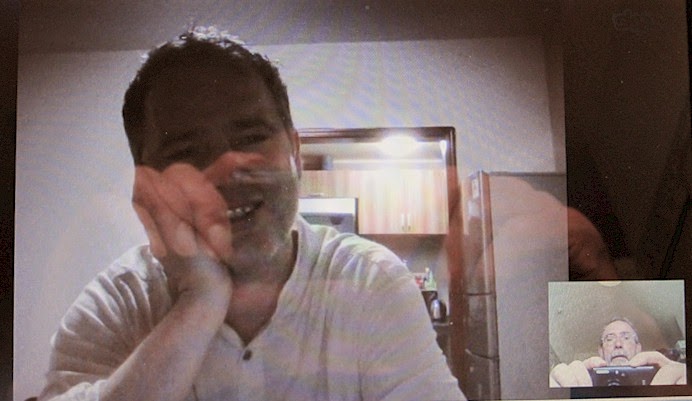
A double Skype selfie...    
It's teatime in Brum, and I'm gassing, for free, with one of our most adventurous musicians, Bangor-born but Birmingham-based Sid Peacock. If you dig into Birmingham's Jazz and experimental music scene, it won't be long before you come across Sid's work. He runs a string of bands, and participates with maybe a dozen more. This week, Sid is seven time zones away, in China - halfway around the world. I am Skyping Sid on an ancient netbook. It's got a camera, so this is a video call. Sid's looking chipper. 


Sid is three quarters of the way through a visit brokered by the British Council, working with the Sichuan Opera and the Chongqing Troupe. It's his third trip.

Tell me where you are, and what you can see?
I'm in Chongqing – Jiangshen avenue. I'm by the new Opera House, in the new Northern District. I'm looking at a new Spaghetti Junction, right outside my window. There's a Spaghetti Junction every couple of miles in this place...
You're a regular visitor now, so you can see the changes.
2006, 2007 and now. Even in the time since 2007, I've noticed a massive change. Significantly. But you know, the conditions for working musicians are excellent out here. 
Are you talking about state funding like they have here, and to a much greater extent in Europe? 
No – there's no funding,. But you can make a living. Since I've been here, I've been offered jobs. They want musicians in bars, in hotels. I've seen a lot of musicians, not all of them that good, who are making a living, at functions and so on. If the guys at the level of working musicians in Birmingham came out here, they could make a living. 
But you look out your window and you see Spaghetti Junction. 
It has its charms. I'm looking out the window now, at 1 in the morning. I see a girl walking home, high heels, miniskirt, walking home. Safe. No fear at all. 
What about air quality? You're a singer or a horn player, you need your lungs.
It's not good. Another problem is that they smoke in the bars, everywhere. Look, it's a bit rugged, a bit rough. But if you want anywhere near that experience of the 40s or 50s, this is the place to be. 
Don't your hosts simply want your Western music chops?
I think so. But you know, they love the Irish songs as well. 
Tell me about the work you're doing there? 
There's lots of musicians and arts organisations that want to meet up. So I'm being ferried about to meet lots of different people. Making some really good friendships that I think will be long term. Getting on really well. We've just done a concert in an arts theatre space: a group of Chinese musicians, a jazz pianist and a drummer from Birmingham. A guy called Max. I don't know his surname. 
What do the Chinese musicians want from you?
I'm working with the Sichuan Opera – that's my main thing – we're just in final rehearsals right now. I think what I'm getting from them, is that they always have to read from the score, they always have to play the tune 'as it is'. What they like now is that they're improvising, making it up as they go along – they're loving it.
You brought that into the mix?
When you hear them play, it sounds like they've been improvising for ever. 
But don't some forms of Chinese music leave room to improvise within a structure?
I think there is, in some areas. But you know, some of the stuff I was doing last night, it was pretty crazy. Free improvisation. Last night, as well, I recited Alan Ginsberg's 'Howl' – they went ballistic. That might have been a China première performance...
Wow. Of course, when he wrote it, back in the day (1955) he was challenging everything. It''s in your face, full of drug references and stories of repression, and urban decay....and of course it was stamped on by the powers that be. He deliberately set out to upset the apple cart. How did it go down?
I'm not sure how many people understood what I was saying – not that many people speak English...
But the rhythm, the sound, the patterns....
Yeah! One girl, a guzheng player, said that when she came to it, she had to decide could she do this or not? And they all decided they could. Guys are all over it in an instant. They decide, and it happens.
I can only judge by the footage that's presented to us here in the UK. The picture I'm getting is of rampant consumerism and a hoovering up of western styles. Last week they showed footage of a rock festival, with a metal band delivering stereotypical stadium rock, and the crowd could have been from anywhere in the world. 
It's the same as in the UK. In the UK, you go to a metal concert, and it's packed out. Go to something a bit more independent and weird, and you'd be lucky to get a hundred people there. 
So let me ask you this: We've seen that massive explosion in local and grass-roots creativity, because of the tools that we can now use, and the way we can send ideas stuff around the world. Is that happening where you are?
Certainly. I think this has been a good trip because it's given people I've been working with the reason to do something different. There was young guy, pianist guy, who was giving me these pieces, and then after we'd done a performance, he was playing like Cecil Taylor. Giving all these clusters with the whole left hand. Totally no fear in having a go. There's a really good jazz guitarist... Now, I'm probably only the second best jazz guitarist in Chongqing, in a city of thirty-three million. But in a city of one million, Birmingham, I'm pretty low down in the ranks. And he just... opened up. So the sort of things we're talking about now is a band of musicians coming out for three months. 
You're coming to the end of your current stint, heading back to the UK next week and resuming duties with your bands (Surge and Peacock Angell). So have you thought about touring your own bands? 
I would love to. Love to. But Surge is a sixteen piece band. And we're turning into a twenty-six piece band, we're adding ten strings to it. We're going to have to get some healthy funding. We're hoping that my contact here from China is going to come over to see that.
The intention is to take Peacock Angell band over to China. We're a six piece so it would be cheaper! Steve Tromans has joined, and then we've added drums...
And have you collected any more new instruments?
I've got quite a few Chinese instruments. I'm looking at things and going 'I've got to stop this...'

Links
Sid Peacock's website, which has a lot more about the China trip. 


See more music posts on Radio To Go


_______________________________________________________________________
 

Subscribe to the mailing list


* required field


Email Format


Sunday, 8 June 2014

The Stuff of Wonder: Miles Hunt and Erica Nockalls

Twenty seven years of solid songs, changing line-ups and killer on-stage monologues

Convention says: if the bastards grind you down, your youthful exuberance will be drummed out of you, and your bright shiny work will be damned and spurned by the new breed. The new breed will, in turn, will be spat out by and swept aside. But they don't know that. Yet.

Durability and craft can work for you long after the business boys write you off. Look at the headliners at this summer's festivals: they're vintage acts. Later this year, the 47 year old Fairport Convention headline their 38th annual festival. High up on Fairport's bill? The Wonder Stuff who started in 1987.

The Wonder Stuff, like Fairport, are sustained by an adoring and loyal audience. They come for Miles Hunt's songs and brilliant on-stage patter. The repertoire works with a full band, and in a duo with partner and fiddle player, Erica Nockalls. That tells you the songs are solid enough to take a whole range of treatments. And it says a lot about on-stage presence.

Sunday, 1 June 2014

What's your music worth? Well, how about asking?


The Bluebeat Arkestra put up an online Honesty Box for their new EP and plugged it on Facebook. Here's what happened.

Dark Disco, Trip-Hop, Funk,    
Electronic  and Breakbeat heaven    
You can get lots of free music online. Much of it is on dodgy torrent sites who stiff musicians illegally. Streaming sites pay tiny royalties and stiff musicians legally. 

What's to be done? Ubercool web marketing gurus tell you to give it away; it's promotion. That's the online equivalent of expecting a band to play for free. 

The bottom line? The web has devalued music. It's great for spreading and sharing ideas. It works fine for me: I like to write. But it's not great for musos who put up money and rehearsal and collaboration time to make their statement. 

A while back, Dave Breeze of The BlueBeat Arkestra told me of their plans to launch an EP with an online honesty box through Bandcamp: download for free and then pay what you like. We fixed to meet up after the release to find out how it went. 

Sunday, 25 May 2014

Diva! Sarah-Ann Cromwell spells it out

Brutal competition, monastic lifestyles, getting nekkid on stage - Opera's not what it used to be...
Sarah-Ann tearing it up at MAC last month    
There's been an interesting ruckus this past week. Critics focused on the size of an Irish singer making her Glyndebourne debut; singers hit back, hard. The central issue is that a singer is a singer, first and last, and appearances are secondary. A further issue is old-school sexism. 

But then again, Opera is also all about the show. It's hard to buy the idea of a willowy Rhine Maiden, or a dashing athletic Siegfried hero, when the person singing tops 20 stone. 

I talked with Sarah-Ann Cromwell this week. She was furious at the critics. Cromwell is building twin careers: Opera... and comedy cabaret. She tried comedy out at the 2013 Edinburgh Festival to rave reviews, following up with a sellout at MAC in Birmingham, which was a total hoot. And by all accounts she played a stormer at Birmingham Pride 2014.